Tag Archives: truth

The Election is not about WHO; it’s about WHAT

Although I started my blog, Treasure in Earthen Vessels, in 2012, it took me four years to write and post my first political writing. I have written only six posts about political issues in those 12 years and 216 writings. Why so few? Because I have had little desire to use my blog to influence my readership in political matters—until today. But God has gotten my attention, and He speaks loud and clear about the election at hand. I do not write this to be critical of either party or candidate, but rather to share with you the things God has shown me from His Word.

Like me, many of you are a product of your family’s beliefs. Thank God that in America we still have the right to disagree and openly speak what we believe. While I highly respect everyone’s personal viewpoint, I am greatly compelled to share with you what God has spoken to me about this election. In the years that I have been married to my husband (a much deeper and more serious thinker than I am), I have on many occasions confessed to him that I was wrong on an issue, be it political or religious. And he has done so as well. We are all in a place of growing up in order to become the people God has called us to be. If I am wrong, I want to know it. I do not want to bury my head in the sand and say, “I’m right because my way of thinking can’t be wrong.” I cannot honestly say that—because I have been wrong. I continually thank God for every truth He brings to me. I diligently try to keep an open heaven above me so I can see truth, grasp truth, accept truth, and once again be made more in the image of Jesus. I would think every child of God would want the same.

For a scripture reference that we can sink our teeth into and be confident that we are making a good application of God’s Word, we are going to read Joshua 5:13-15 from the New King James Version. These verses have something monumental to say to us.

Joshua 5:13 ~ And it came to pass, when Joshua was by Jericho, that he lifted his eyes and looked, and behold, a Man stood opposite him with His sword drawn in His hand. And Joshua went to Him and said to Him, “Are You for us or for our adversaries?” 14 So He said, “No, but as Commander of the army of the Lord I have now come.” And Joshua fell on his face to the earth and worshiped, and said to Him, “What does my Lord say to His servant?” 15 Then the Commander of the Lord’s army said to Joshua, “Take your sandal off your foot, for the place where you stand is holy.” And Joshua did so.

If the readers of my blog are like the political polls taken during this election, then half of you are on one side and half is on the opposite side. My greatest desire is that you will hear for yourself how the Commander of the Lord’s army answered Joshua. Joshua merely asked: “Are You for us or for our adversaries?” To make this question more applicable to the election, I am going to rephrase it like this:

“Which side are you on, God, ours or theirs?”

Even more telling is the response the Commander of the Lord’s army gave to Joshua. He simply answered, “No….” I like the New Living Translation for this response better. It says: “Neither.” Did you see that? Did you get that? Can our hardened, calloused souls hear the words from the mouth of God to us today? I’m going to paraphrase this one also:

God said, “NEITHER! Neither Right nor Left, neither Democrat nor Republican, neither Liberal nor Conservative. Period.”

God is on neither side of our petty differences; our outdated reasonings about who is right or wrong; or what generations before us viewed and held as important. We are living in a different day, a different culture, and a totally different political climate. We are living in the last of the last days, dear ones, and there is one critical thing that we must catch here. It is this:

“…but as Commander of the army of the Lord I have now come.”

I joyfully announce to you today that Commander Jesus has now come to help us maneuver our way through this mind-boggling battlefield, not against each other, but against the onslaught of demons from hell that are attacking us, our faith, our freedom, our nation, our friendships, and our churches! And trust me, the enemy intends to fight dirty and win at all costs.

But praise be to God, Jesus has now come to help us!

God has His own opinion, purpose and plan for our world, our nation, and our individual lives. And, it is immensely higher than anything that we think we know. God’s mindset is always more godly, pure, and noble than our earthly mind can comprehend. That is the mindset you and I must seek before we cast a vote in this election.

I believe the biggest mistake we are making in this election is in trying to decide “who to vote for” rather than “what to vote for.” Isn’t that just like the enemy to get us focused on the wrong thing? Forget personalities. Take all of the name calling out of the decision criteria because both sides are doing much of it. The devil is having a hay-day at the expense of our unity.

Please know that the Devil is a deceiver and he is cleverly making us think that everything we see and hear is true. If your only source of news is the mainstream media, you have little awareness about what is true and what isn’t. I recommend a mixture of news. Also, please you look up some well-known and respected Christian leaders of today and see what they are saying about this election. For example, find Franklin Graham, Anne Graham Lotz, or Max Lucado.

For us to get a Biblical grip on deception, let’s explore another scripture: Galatians 6:7-8. I’ve chosen the Amplified Bible mostly for the clarifying words in brackets.

Galatians 6:7 ~Do not be deceived, God is not mocked [He will not allow Himself to be ridiculed, nor treated with contempt nor allow His precepts to be scornfully set aside]; for whatever a man sows, this and this only is what he will reap. 8 For the one who sows to his flesh [his sinful capacity, his worldliness, his disgraceful impulses] will reap from the flesh ruin and destruction, but the one who sows to the Spirit will from the Spirit reap eternal life.

The first thing for us to discern in Galatians 6:7 is this: If it is in the Bible, then it is spoken to us—to you and me. When the Word of God says, “Do not be deceived,” it clearly means that good, godly, precious Christian people are capable of being deceived. In this case, regardless of whether you are politically red, blue, or purple—you can be deceived. Accept it. Next, do the very thing we should do about all Biblical statements: ASK GOD IF WE ARE SEEING THINGS CLEARLY and THEN LISTEN FOR HIS ANSWER.

We have all fallen for deception at some time in our lives. It is a characteristic of the fallen human race. Our forefathers were deceived and believed the lies of Satan. It has happened in all generations. Yet, it is no high-crime to be deceived. Let’s make a short trip down memory lane to prove it. Have you ever fallen for a lie that a fast-talking salesperson talked you into? Have you ever misjudged someone’s character and loaned them money that you never saw again? Have you ever believed you might win the lottery and get a million dollars? Have you ever bought into a “get-rich-quick” scam? Have you ever trusted a person who turned out not to be the person you thought they were? Have you ever been disappointed in a friend or spiritual leader that misled you?

WE HAVE ALL BEEN DECEIVED, and the only thing we can do about it is to call on Commander Jesus, repent and accept that His blood has taken care of our mistakes. We must humbly accept that we did not see or know that everything we swallowed wasn’t true. It is a low blow to our pride, but we must repent and get beyond it. It is important to seek for truth in any area in which we are susceptible to the lies of our enemy. Those are generally the areas we are so sure about.

The next phrase in Galatians 5:7 is “…God is not mocked.” I chose the Amplified version for these very words: [He will not allow Himself to be ridiculed, nor treated with contempt nor allow His precepts to be scornfully set aside]. Clearly, people will not get away with mocking or ridiculing God. And His principles cannot be set aside; such as reclassifying abortion as health care. He will not allow this.

Here is what we must consider: What policies does each side support that clearly align with God’s Word and God’s principles? With God’s Word as the only measuring stick, carefully weigh the issues, and determine if the platform and policies of the political party you are leaning toward align with Biblical values. While there are many issues, the ones that Christians must know about before voting are these: abortion; same-sex marriage; number of genders; lawlessness; and support for Israel? If their position on such key issues is opposite of the Bible, then you will be voting against God’s Word and His principles.

I want us to look again at the conversation between Joshua and the Commander of the Lord’s army in Joshua 5:14b-15 ~ And Joshua fell on his face to the earth and worshiped, and said to Him, “What does my Lord say to His servant?” 15 Then the Commander of the Lord’s army said to Joshua, “Take your sandal off your foot, for the place where you stand is holy.” And Joshua did so.

We must ignore the political jargon and recognize that along with Joshua, we too are on holy ground where the Commander of the Lord’s army is standing. It’s highly possible that like Joshua we need to fall on our faces, worship Him, and ask what He has to say to us. This ground is holy because God is there. Holy because principles matter to God. Holy because God’s people are called upon to stand where God stands. (Don’t miss that one!) Holy because each of the issues considered are godly principles—not just made-up views to help a candidate get elected.

It is interesting to note that Joshua was told: Take your sandal off your foot. Do you wonder what those sandals might represent? I believe our sandals are what got us to where we are today—to where we have walked thus far. Could that perhaps be our ideas and beliefs that have gotten us to this place—politically and spiritually—such as our teaching, doctrines, and family traditions? Could the angel have told Joshua to remove them because they won’t serve him well here on this holy ground? We simply cannot come into the presence of a holy God with unholy beliefs and values. It is important to notice that: And Joshua did so. Can we or will we obey like Joshua did?

We all need to understand that here in this place God is requiring us to grow up, reach further, and rise to a higher place of thinking; of discernment; of responsibility; of accountability—to a place that is holy—where our personal opinions and preferences must be taken off and left behind. As Christians and Americans, we are in this very hour being compelled to put aside our feelings, thoughts, and family traditions; and ask the Holy Spirit to reveal to us God’s mindset about this election. We are promised in John 16:13 that He will lead us into all truth.

Undoubtedly, we will soon see more about God’s higher plan because Christ’s coming is closer than we know. But for now, we must seek to know what things the Commander of the Lord’s Army would have us do—including how to vote in this election. So, our question for today is this: Are we willing to seek God so that all of us—as God’s beloved children and the largest voting-block in America—will be united and vote as the Holy Spirit leads us to vote?

Dear one, please understand that you are very precious in the eyes of our Heavenly Father. And you are also precious to this servant girl of the Lord who does her best to seek His face continually, to hear His sweet and tender voice, and to obey her beautiful Lord. Until next time, blessings to you all ~ Sarah Jane

If your heart has been touched or stirred by this post, please share it with your friends and family. If you are subscribed to my blog, you can forward your email to them or if you are not subscribed, simply hit the share button on FaceBook.
What Will We Focus On—A Messy World or A Majestic God?

I was late coming outside for my morning walk with God because of lingering too long in a book by my newest favorite author, Lilias Trotter. She had quoted Augustine of Hippo’s striking words about our origin: “Thou has made us for Thyself, and the heart rests not till it rests in Thee.”1

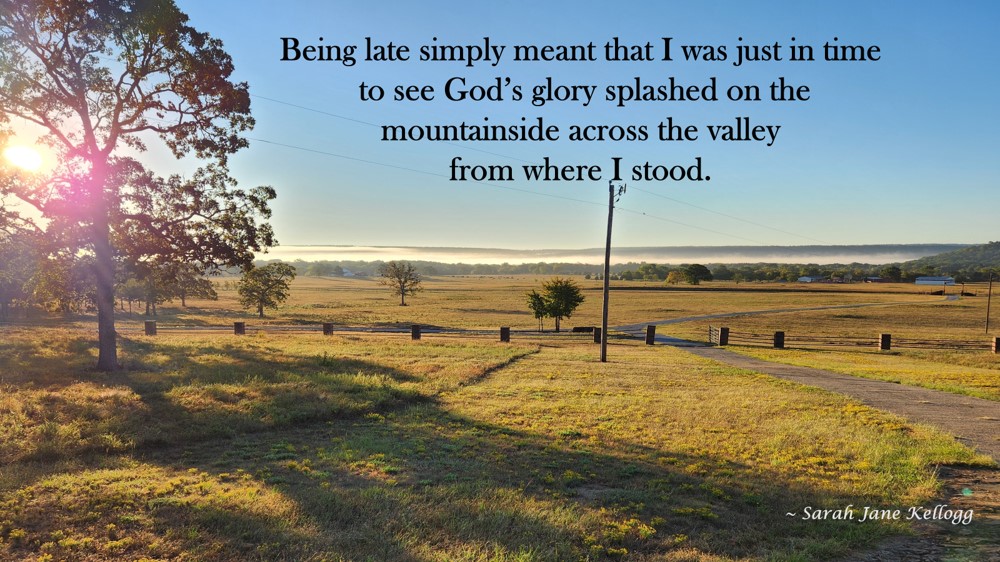
As I hurriedly stepped off my porch, walked past the trees and out into the opening, I quickly realized being late simply meant that I was just in time to see God’s glory splashed on the mountainside across the valley from where I stood. What I saw is called a temperature inversion. It is opposite of normal atmospheric conditions, where air is warmer near the ground and colder at higher altitudes. It took my breath away as I hurried to snap a few pictures.

I glanced at the sun and saw majestic sunbeams peeking through the trees as if to catch a glimpse of that cloud inversion over on the mountains. My heart erupted: “O God, I see you. I sense you. I feel you.” I heard His soft response, “Be still and know that I am your God.”

Can I? Can we—be still? We must know Him as our God, if we want to live forever. It’s that simple—believe He is who He says He is and trust Him. In the cool morning breeze, geese flying south interrupt the quietness with loud quacking. I scarce can take it in. It is refreshing moments—far away from the disturbing hatred that quacked from the television last night. God knew I needed a mind reset.

I never dreamed I would live to see America on the brink of collapse, destruction, and ruin—things that threaten the very foundation of our nation. It is hard to comprehend, yet it lurks powerfully in front of eyes that can see it. Things feel upside down—inverted one could say—like when cold air and warm air change places. Good people support bad leaders and things God would never condone. Strong believers are being deceived to accept another gospel. I struggle to wrap my mind, much less my heart, around it all.

Last evening the news reported an attack on one who fights for our country. I did some research and discovered that more than one million service men and women have fought and died for this country since the Revolutionary War. I wonder if I will be willing to fight when the fight comes to me. Only God knows.

God woos my thoughts back to Himself, “Keep your mind stayed on Me; focus on My Kingdom.”

As I struggle to redirect my thoughts, His invitation came, “Rest your heart in Me.”

True heart-rest comes only from God. Which will I choose today—to focus on a messy world or a majestic God? It’s my choice as well as yours. Our choice determines our state of mind: a state of peace or a state of turmoil. No matter what comes or goes, we must be on the side of God to have any chance of finding peace. We must practice His presence with us daily—perhaps hourly as the prophesied hour approaches. I perceive this is the only way to survive the last days on earth.

There are two worlds at war. According to Augustine of Hippo, we were made for only one. We belong to only one. Our lives can find peace in only one. Only one offers eternal life. So, we must let go of the other—the one we don’t belong to.

Our life is hidden with Christ, in God, according to Colossians 3:3. That is where we belong. Focus on that life because the other is but a vapor—like the inverted clouds on the far mountainside. With every passing moment, it is slowly fading away and almost out of sight.

James 4:14 tells us, “How do you know what your life will be like tomorrow? Your life is like the morning fog—it’s here a little while, then it’s gone.” (NLT)

We all have a choice of what we will focus on today. I highly recommend the Majestic God, especially since He made us for Himself.

~Sarah Jane

1 Lilias Trotter, The Way of the Sevenfold Secret, Lilias Trotter Legacy Inc., 2023, Mt. Dora, FL, p 14

STUDY GUIDE FOR CHAPTERS 13 & 14 ~ THE END AND THE CONCLUSION

A note from the author: When I sit down to write a study guide, I never know where the Holy Spirit is going to take me. I am so excited about where He took me on this one. This message is a matter of life or death. Expect God to speak directly to your heart about the most important decision of your entire life. The conclusion to your story is at stake. ~ Sarah Jane

1.  The Beginning of Our Story (Chapter 13)

Every story has a beginning and every story has an ending. That’s the cycle of life as well—we begin somewhere and we end somewhere. It is basically the Creator of all life who determines our starting place—what millennium, century, era, year, month and day, as well as what country, nationality, race and family we are born into. He chooses the important details about us as He sees fit, simply because He is in charge of all things beyond our ability to determine. After all, He is God.

However, we do have the capacity to understand that we are the created of God, and Bible tells us just how our Amazing Creator did it. Get ready to be amazed as we read these captivating words by King David in Psalm 139:13-16 (NKJV):

13 For You formed my inward parts;

You covered me in my mother’s womb.

14 I will praise You, for I am fearfully and wonderfully made;

Marvelous are Your works,

And that my soul knows very well.

15 My frame was not hidden from You,

When I was made in secret,

And skillfully wrought in the lowest parts of the earth.

16 Your eyes saw my substance, being yet unformed.

And in Your book they all were written,

The days fashioned for me,

When as yet there were none of them.

Dear one, you have a beginning and it began with God. He chose the big details about you, and He also chose the intricate details about you—the color of your eyes, your hair, your height, and the dimples in your cheeks. You are fearfully and wonderfully made, and God’s works are marvelous. That means YOU are marvelous, because you are one of His works! He also chose and shaped the days you will live upon the earth before one day of your life was even here. He loved you, His created one, so much that He recorded your days in His forever book. How does that knowledge about God make you feel?

_________________________________________________________________

2.  The Middle of Our Story (Chapter 13)

As wonderful as it is, that is not all God has to do with your existence. He was not only involved in the beginning of your story; God is also right smack-dab in the middle of it as well. He knows you through and through, every fiber of your being and every intent of your heart and mind because He’s the One who made you the way you are. King David spells it out in the same chapter in Psalms. Read these incredible words slowly to grasp their meaning. Psalm 139:1-6 (NKJV).

1 O Lord, You have searched me and known me.

2 You know my sitting down and my rising up;

You understand my thought afar off.

3 You comprehend my path and my lying down,

And are acquainted with all my ways.

4 For there is not a word on my tongue,

But behold, O Lord, You know it altogether.

5 You have hedged me behind and before,

And laid Your hand upon me.

6 Such knowledge is too wonderful for me;

It is high, I cannot attain it.

In other words, the Master Sculptor knows every word you speak and every thought you think. God knew where David was every moment of the day, whether he was sitting up or lying down. David said that God had a hedge around him, and was in front of him and behind him. In fact, David stated that God’s very hand was upon him. David described that as a wonderful thing.

I wonder why David thought that was a wonderful thing, since most of us like our privacy. I believe it was because David knew that the God who created him was on his side! God was for him and not against him. David recognized that having the most powerful force in the universe watching over him and looking out for him 100% of the time was a huge plus in his favor. How about you? Do you know that God is on your side? _______ That God is for you and not against you? ________ Explain if that makes you feel good or not-so-good.

__________________________________________________________________

__________________________________________________________________

3.  The End of Our Story (Chapter 13)

At the end of my book, There Is Life after Tragedy, I describe how all of my relatives who were not Christians at the time of the tragedy eventually came back to the God of their parents. “Not one of them dared to miss heaven” because they grew up being taught that God was real and that God loved each one of them. I don’t know where you are in your journey, but you need to understand that while you didn’t have any say in where, when, and to whom you were born, and that God watched you all the years in the middle of life, protecting, drawing, and tugging at your heart, whether you wanted Him to or not—you do have a say in the end your earthly life. We are going to look at one more passage of scripture that could be the most valuable verses in all of these many weeks of studying the Bible. It is found in that same chapter—Psalm 139:7-12 NKJV

7 Where can I go from Your Spirit?

Or where can I flee from Your presence?

8 If I ascend into heaven, You are there;

If I make my bed in hell, behold, You are there.

9 If I take the wings of the morning,

And dwell in the uttermost parts of the sea,

10 Even there Your hand shall lead me,

And Your right hand shall hold me.

11 If I say, “Surely the darkness shall fall on me,”

Even the night shall be light about me;

12 Indeed, the darkness shall not hide from You,

But the night shines as the day;

The darkness and the light are both alike to You.

What we glean from these verses is that the God who made you will not let you slip away from Him without trying over and over to get your attention. In fact, you will not be able to get away from Him. You cannot run far enough to get out of His reach. Isn’t it just remarkable to think that this mighty, powerful God loves His creations that much! He wants you to spend eternity in Heaven with Him, and He will go to all lengths to bring you to Himself. He cares more than you have ever imagined possible. Today He longs for you to stop running and let Him catch you. If this describes you, have you ever thought about these two questions:

“What have I got to lose, if I give my heart to God?” _________________________________________________________________

“What have I got to lose, if in the end I have not responded to God’s love for me?”

__________________________________________________________________

A loving God patiently awaits your answer. You alone have control over the end of your story and where you will spend eternity. Not God. Not anyone. Only you.

4.  The Conclusion of Our Story (Chapter 14)

I tend to think of a conclusion as the wrap-up of an event or process. It is when all is said and done, or when it’s over and the results are in. In reality at the end of life, a conclusion means one thing: Where we will spend eternity. The opportunity to change our mind is past. The ability to think again has disappeared. The chance to have overs is forever gone. We will all have one of two conclusions: Life forever in heaven with a God who has loved us since the beginning, or life forever in a place of darkness away from God.

Stop for a minute, turn off the noise, lean back and relax. Now close your eyes and take in a long deep breath of air. Allow your mind to slip into neutral as best you can, and then ask yourself these questions: Have I ever stopped long enough while living this life God has given me to realize where it came from? Have I ever considered that there is a Creator who intentionally made me the way I am? Have I ever thought that I am the object of His love, His hope, and His joy? Be honest—have I believed these statements or do I believe what I’ve only heard about God? If so, was it from a reliable source?

__________________________________________________________________

What else would your Heavenly Father have to tell you to make you believe how excited He is over you? More scriptures? The Bible is full of words that describe His love for you. You are His magnificent creation. His love is reaching for you. His love is encircling you, desiring to capture your attention. He has been looking for you for your entire life. He has been calling out to you and chasing you down with His blessings. He cares deeply for you. And He longs to reveal His love to you—if only you would welcome Him into your life.  

How about today—right now—would you turn your heart toward the Lover of your soul? No one has ever loved you like Jesus Christ loves you. No one else died for you—in your place—except Jesus. No one else can offer you eternal life in heaven. There are only two options when you die: one is a wonderful choice, and the other is the worst conclusion to any life. My prayer for you is that right now you will pray the following prayer and ask Jesus to come into your heart and save you. It will be the best decision of your life. I promise.

Prayer: Dear Heavenly Father, my heart feels something stirring inside. I have never actually given you the opportunity to catch me, but I’m tired of running. My plans haven’t worked out so well, so I would like to try your plan. I am sorry for my sins and my bad choices. I ask you to forgive me and give me another chance. I invite you, Lord Jesus, to come into my heart and change me into a new person. I want to spend eternity with you in heaven. Thank you for saving me right now. In Jesus’ Name I pray. Amen.

If you just prayed this prayer, please leave me a comment under Study Guide for Chapters 13 & 14 on my website: www.sarahjanekellogg.com and I will respond.

STUDY GUIDE FOR CHAPTER 6 ~ THE AFTERMATH

1.  What Does Aftermath Mean Anyway?

Up until this one, the previous lessons have flowed easily from my heart. I did not have to search for ideas, content, or questions that brought rhyme and reason to the topic to be discussed. They were just there—right on the tips of my fingers as I typed. So why is this chapter different? Could it be because none of us want to talk about painful things?

In my book, There Is Life after Tragedy, I started Chapter 6 with the following words: “Aftermath seems like an ugly word to me….” If you have suffered a great loss of life, you know exactly why aftermath is an ugly word. For those who have endured one or more deaths at the same time, the ugliness is multiplied many times over. Tragedy can exponentially increase the pain and heartbreak as the reality of the loss soaks into our hearts and minds. In short, it is indeed ugly.

Do you know any other descriptive words that clearly depict aftermath?

__________________________________________________________________

__________________________________________________________________

Although aftermath is ugly, it is also normal and necessary. We will all have to deal with aftermath someday, even for the loss of a loved one who dies of old age. Why? Because loss of life always forces us to face the “What’s next for me?” question. The many changes and challenges that lie ahead make up a large portion of the aftermath. What used to be is no longer. Who used to be with us is not here anymore. In fact, for many people, everything changes.

On page 46 of my book, I listed fifteen unpleasant things that humans have to deal with that create an aftermath in our lives. Things such as death, accidents, divorce, coronavirus, etc. However, I have come to realize that the list is not a complete list, and I’m not sure there is a complete list. Perhaps that is why the last line of my list says: “after, after, after….”

What gut-wrenching life events could you add to my list?

__________________________________________________________________

__________________________________________________________________

The Oxford Dictionary defines aftermath as “consequences of a significant unpleasant event.” While we may not classify all losses as tragic, we must understand that tragedy comes in many shapes and sizes. Sometimes we have to clean up a mess someone else made, and sometimes we have to clean up our own mess. Regardless, we all need one thing in order to survive the aftermath—God!

2.  We Are Never Alone

God never expects His children to go through any part of life by ourselves. We always have His Presence with us. We always have His Peace inside us. We always have His Grace covering us. If we have asked Jesus to save us and send the Holy Spirit to come and live in our hearts, then He did both of those things. The truth is that we are truly never alone! Our challenge is to learn how to tap into that Source that indwells all believers.

To get over this mountain called aftermath, we simply must lean on God’s promises to get us there. He means what He says, and we can trust what He says in the darkest hours of life. If He fails us there, how can we trust Him with our eternal destiny? It is a rock-solid, iron-clad truth that God’s Word never fails!

What can you do right now to get that one issue settled in your heart and mind once and for all?

__________________________________________________________________

__________________________________________________________________

For our scripture reading for this lesson, I want us to look at Isaiah 43:1-3a. I have included it below from the New Living Translation.

1 But now, O Jacob, listen to the Lord who created you. O Israel, the one who formed you says, “Do not be afraid, for I have ransomed you. I have called you by name; you are mine.

2 When you go through deep waters, I will be with you. When you go through rivers of difficulty, you will not drown. When you walk through the fire of oppression, you will not be burned up; the flames will not consume you.

3 For I am the Lord, your God, the Holy One of Israel, your Savior.

If we read Isaiah’s life story, we would realize that he had firsthand knowledge about deep waters, rivers of difficulty, and the fires of oppression. He was certainly validated to write about such hard things. His words of comfort to us in these verses are encouraging to say the least. The truth is that Isaiah knew these statements by experience because he had trusted in God for survival and God did not fail him.

Have you ever had a situation in your life when you trusted in God and then experienced His divine help where you were not afraid, not alone, didn’t drown, or were not consumed by your trials? Those kinds of experiences are truly a hallmark of our faith in a Faithful God. Briefly list one or more those experiences below.

_________________________________________________________________

_________________________________________________________________

3. What’s So Amazing About Grace?

Obviously, I believe that God’s grace is amazing since I donated over two full pages to that subject in my book. Actually, grace is a big deal. Without it we would all be in big trouble—in this world and in eternity. Ephesians 2:8-9 says, “For by grace are you saved through faith; and that not of yourselves; it is the gift of God: not of works, lest any man should boast.”

Grace is a gift God has chosen to give to His children. We cannot earn it, buy it, steal it, borrow it, or con God out of it. All we can do is ask for it, believe He says “yes” to our prayers, receive it by faith, and testify to what He has given to us. In real terms, God gives us grace because He wants to.

When it comes to receiving God’s help to survive an aftermath, our greatest ally is grace. It is freely supplied to those who ask Him for it. You may be thinking—but how do we receive this grace; how do we make it ours? The answer is clear: we receive grace exactly the same way we got saved—by faith! We will receive grace through faith, making faith the vehicle by which grace becomes a reality in our lives.

We’ve already settled the fact that God cannot lie. Since God is incapable of breaking a promise, then any disconnect must be on our end. When we think He is silent, think again. God doesn’t have to use words—His presence, peace, grace, and love all speak volumes to our hurting souls. So, in those times when it seems as though God is silent, we must use our faith to stir our faith!

But how do we use our faith to stir our faith? It’s basically quite simple. If you are a born-again believer is Jesus Christ, you only got there one way—by faith, as discussed above in Ephesians 2:8-9. Read this next sentence very carefully: you already have faith inside of you. It just needs to be activated once again—stirred up, if you will. You don’t need to start asking God for something you already have. We simply recall or bring to our remembrance the times He has blessed us, answered our prayers, and showed up just in time. Our trust in Him is what God responds to—not begging! Tell Him you trust Him, and mean it. Practice doing what you did at least once in your life. Then practice it again, and watch Him smile down some grace on you, along with hope, comfort and strength in your dark moments. It is true—grace is amazing!

Think of a current issue that is difficult for you to manage. Why not ask God for His amazing grace to help you get through this time? Briefly identify it here, and later come back and record what God did for you.

__________________________________________________________________

__________________________________________________________________

Record follow up here:

__________________________________________________________________

__________________________________________________________________

If you have never asked Jesus to forgive you for your sins and give you eternal life, why not ask Him right now? He is always ready and willing to answer that prayer, and He will come into your heart and save you. Next, share your decision with another Christian. You can also leave me a comment in the comment section, and I will respond to you.

Prayer: Heavenly Father, I am learning just how much I need you, and that you are more than willing to help me through the difficult times. I am grateful for your faithfulness and no matter how hard life looks, I am never alone and your amazing grace is always available to me. With every trial that comes my way, my faith is growing and getting stronger. I long to trust you more. Help me remember to ask for your help, believe I will receive it, and give you thanks in everything. In Jesus’ Name I pray. Amen. 

STUDY GUIDE FOR CHAPTER 4 ~ THE FAMILY I KNEW

A note from the author: This Study Guide will take us to new places we may have never thought about going. We will likely learn new things about ourselves, but even more about our family. We all have one; and whether we like them or not, we are like them in many ways. You will also find some ideas on how to mend the fences with your people. So, let’s get going! ~Sarah Jane

1.  Who Are Our People?

We all have what we call our people, our tribe, or our clan. The most common term is simply our relatives, for those with whom we are biologically related. We also know this group of human beings as kinfolks, because we are kin by blood. We share many things with these individuals—mainly, but certainly not limited to, the blood that runs through our veins. We also share genetics, physical features, good or not-so-good looks, and temperaments. Oh, but it goes even further than that—there are talents such as being able to sing, dance or play an instrument that can be traced back to our kinfolks. Equally true, the qualities of high intelligence or exceptional athletic capabilities also run in families. Further still, we often hold the same religious views, political views, and societal views.

Whether we like our kinfolks or not, we are like them in many ways. There were several things I discovered about my family during the data gathering process for my book that I did not know beforehand. I did not know that almost every member of my dad’s family played a musical instrument. All I knew was that I loved music with every fiber of my being. I guess I thought everybody loved music as much as I did—after all, what’s not to love about music?

Is there something about YOU (a trait, skill or desire) that you wonder where in the world it came from? __________ Describe it below.

__________________________________________________________________

I must ask: Have you looked around at your kinfolks? __________________________________________________________________

2.  Childhood Memories

Childhood memories are something we all have. I have wonderful memories as a child growing up around my people, and I cherish them even more today now that I’ve written about them. But good or bad, our memories are what they are. If yours are not so good, I encourage you to face them with courage. You can’t change your memories, but by addressing them, you may see some things differently now that you are an adult.

Without disclosing any facts about your hurtful memories, make a note here of a memory you possibly need to face.

__________________________________________________________________

__________________________________________________________________

Some people keep bad memories suppressed for years. That is generally not a good idea as it can eventually lead to mental anguish that pushes individuals to carry out revenge on family members, co-workers, and even innocent people. I recommend getting professional help, be it through a counselor, pastor, or friend. Life is too short not to live it to the fullest. God wants His children to live in total freedom from our sin, our past, and our bad memories. Let’s look at two chain-breaking statements Jesus made while He was on earth.

John 8:32 “And you shall know the truth, and the truth shall make you free.”

Jesus deeply cares about our freedom. He knows that truth has inherent qualities when brought into the light of His love that can bring freedom to our lives. It is knowledge of the truth that breaks off our chains. Listening to and believing lies does the exact opposite.

John 8:36 “Therefore if the Son makes you free, you shall be free indeed.”

Here Jesus heralds Himself as the Master over bondages, chains, addictions, lies, deceit, half-truths or any other life-suffocating obstacles. And He announces that if He sets us free from any of those relentless monsters, we will truly be free!

Rewrite these two scriptures and insert the pronouns I and me in the place of you.

__________________________________________________________________

__________________________________________________________________

__________________________________________________________________

__________________________________________________________________

3.  Strained Relationships ~ What Can We Do?

For more than four decades, I have been friends with a family of five daughters. I have watched them live in close proximity to one another and their parents. Not once have I known of a dispute among any of them, nor one bad word spoken about another. They live life together, and some have worked together. They share the responsibility of taking care of elderly parents and do it well. They truly earn a five-star rating in my mind, and they are greatly admired as a family by anyone who knows them. But unfortunately, they are not the norm. It isn’t uncommon to have issues with our people. So, what can we do about our strained relationships?

While some bad behaviors are intentional, a large part of family issues are caused by misunderstandings. The enemy of our souls continually spins and spreads half-truths. If not dealt with, these misunderstandings can change a molehill into a mountain. The longer they are allowed to go unchecked, the bigger the issue becomes. It is often necessary to “eat crow” to get some issues resolved; yet I believe in most cases our people are worth the effort to restore the relationship.

If you think your family’s issues are over-the-top, think again. Let’s look at several examples of family issues from the Bible to see if they were all perfect people with perfect relationships.

Cain and Abel, sons of Adam and Eve and the first two siblings on earth: Cain was jealous of Abel, so he killed him. Not so good, huh? (Genesis 4:1-8)

Isaac and Ishmael, the half-brothers of Abraham: Descendants of both of these men claim they are from the son of promise that God gave to Abraham. This battle still rages today in the Middle East. (Genesis 15:1-8; Chapters 16; 17; and 21:1-21)

Jacob and Esau, the twin brothers of Isaac and Rebecca: Jacob, the younger brother, stole his older brother’s birthright. That is a really big deal in Jewish families. (Genesis 25:19-34)

Joseph and his 11 brothers, the sons of Jacob: The brothers were jealous of Joseph because he was their father’s favorite, so they sold him into slavery. The twelve sons of Jacob were born to four different mothers. Want to talk about a challenge? (Genesis 37:1-36)

These examples are from just the first book of the Bible! But in case you thought your family situation is the absolute worst, these stories should help put things into perspective. Dysfunctional families have been around since the get-go!

4.  How Do We Move Toward Reconciliation?

Sections A through D below are good ideas that could help you resolve some issues with family members. They are certainly not to replace professional help, but rather to provide some simple keys that work for many people. The actual keys are underlined.

A.  The first key is that you must desire to fix things with your family member(s). You will have to make the first move—through prayer and self-reflection. Ask yourself, “Why do I want to fix this?” Record your reasons below.

__________________________________________________________________

__________________________________________________________________

B.  If you truly want to reconcile, the next two keys are: forgiveness is essential, and accusations (blame) must stop. Determine in your heart now if you can do these two things. What role does forgiveness play here? What about blame?

__________________________________________________________________

__________________________________________________________________

C.  Be willing to meet them half-way. In so doing, you are accepting that part of the problem could be you. Why is this step important?

__________________________________________________________________

__________________________________________________________________

D.  Move forward with caution, respect, kindness, and love. Simple kindness may be the most effective key you use. Remember that love never fails—and it will not fail you or fail them. Which of these four words can you see yourself using? __________________________________________________________________

__________________________________________________________________

E.  Everybody has a perspective and it could be different than yours. Everyone is important to God and is one of His offspring. Every person is worthy of mercy and grace, since Jesus died for all of us. Why must we extend mercy and grace to those who don’t deserve it?

__________________________________________________________________

__________________________________________________________________

These simple steps are not a fix-all by any means, but what if God restores a relationship that has been broken for half a lifetime? Believe now that “He is able to do exceedingly abundantly above all that we ask or think!” (Ephesians 3:20)

Please understand that the good ideas and simple keys above are presented as possible solutions for typical and ordinary misunderstandings and behaviors in families. They are not offered as a solution for every offense, especially in the case of harmful actions like sexual abuse. Reconciliation may not be possible in some cases, and those kinds of offenses need and deserve professional counseling.

I have covered many thoughts and ideas to help you deal with your family matters. I pray in the coming days that the Holy Spirit will speak to your heart which ones can help you find healing, health, and wholeness in everything family!

Prayer: Heavenly Father, I acknowledge that my childhood memories are certainly not like a fairytale. In fact, there are some issues with my kinfolks that I would like to reconcile. I have no idea how it will be received, but thank you for bringing me to this point of acknowledgement. Oh God, grant me the serenity to accept the things I cannot fix, the courage to fix the things I can, and the wisdom to know the difference.1 Please help me to honor You in whatever I do with this new insight. In Jesus’ Name I pray. Amen.

1 The Serenity Prayer, modified by author

A SIMPLE EASTER

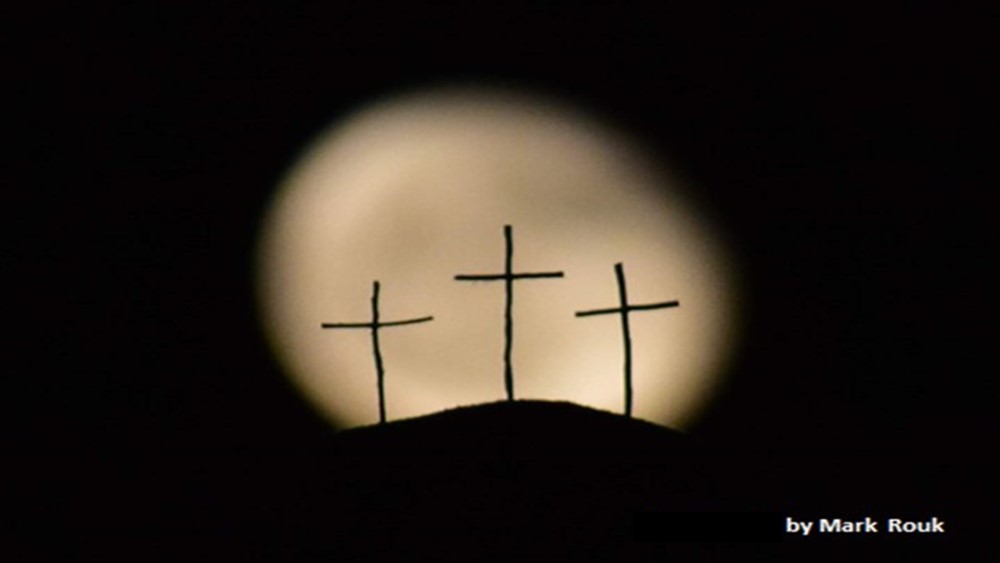
My longtime friend and photographer, Mark Rouk, created this picture a few years ago. It is my all-time favorite Easter picture. I’m guessing he used some simple things like a mound of sand, a few twigs, a drop or two of superglue, a black cloth, and a flashlight. Regardless of what he used beyond his own amazing creativity doesn’t matter—it is the message that his simple silhouette speaks to us.

Defining Easter can be huge or minuscule, depending on your audience. If one is writing a dissertation, it could get deep and complicated really quick. But if it is telling a child what Easter is about, a simpler definition will work. Basically, Jesus loves us so much that He died on a cross for our sins. Enough said, huh? Sometimes a simple Easter is in order for our crazy-busy lives.

I am beyond the age of having kids and even grandkids young enough to hunt Easter eggs. Those were simple days—wonderful days with priceless memories. We dressed our children in the best Easter apparel we could afford—matching shirts and slacks, frocks and frills, shoes, hats and Easter baskets. After the Easter Sunday Morning Church Service, we all made our way to Gramps and Granny Kellogg’s house for lunch. Our sweet Granny Grace’s Easter egg hunts are forever lodged in our hearts. But before the hunt could take place, we gathered in the kitchen where every inch of countertop, the cooktop and the kitchen table were filled with dishes of delicious food. Everyone ate their fill with joy and laughter—while holding off the kids as long as possible to give the teenagers time to hide the eggs. Then the race was on!

I suspect your past Easter Sundays were much like mine. It seems as though they were a lifetime ago. Yet today, I hear my Lord speak priceless words to my heart: “Sarah Jane, slow down and have a simple Easter this year.” I don’t know about you, but I’m in need of a more-simple lifestyle altogether. See if you can relate.

I need to manage my intake of frightening news from around the world—and my best guess is to simply turn it off. I need to worry less about all the corruption in our nation, and simply focus on the good. I need to care less about just the right clothes, shoes and purse, and simply be content with what I have. I need to stop fretting about all the high prices (and God knows they are everywhere), and simply settle for less going, less buying, and less eating. I need to spend less time on frivolous and unnecessary things, and simply do more things that make my Lord, my family, and my friends smile.

I’m sure you’ve heard the K.I.S.S. principle—Keep it simple, S______.” The Lord just gave me the idea to insert the word “Sweetie” as the fourth word in that phrase. So, here’s my advice for a wonderful Easter this year: “Keep it simple, Sweetie!”

A HAPPY AND BLESSED EASTER TO ALL! ~ Sarah Jane

STUDY GUIDE FOR CHAPTER 3 ~ THE HISTORY

A note from the author: The lesson for Chapter 3 may seem a bit off-target since it focuses on things that happened long ago—better known as history. You may ask, why do I care? Or why should I care? But you will soon discover that our history is very much a part of who we are today. So, dive in and see where God takes you! ~Sarah Jane

1.  History Matters to Us

In my book, There Is Life after Tragedy, I described history like this: “I like to think of history as looking in a rearview mirror. You’re not going that way, but it does give you a small glimpse of where you’ve been.” History matters to us—or at least it should. Yet, I know there are many who would rather not know their family history just because it feels tainted or spoiled, and you’re thinking why not just leave that stone unturned. That may well be an accurate description, but it also may not be. The truth is that you will never know for certain unless you try to unpack your own history. Only you can make that decision.  

Just in case you think you might like to take a peek at what’s out there about your family, there are some things you may want to consider. It is sad but true that many of us seem not to care about our history until it is too late. Oft times family members leave us way to early, and we are left with a thousand questions we intended to ask them someday. I’ve seen it happen many times. So, take my advice—since it’s free—and get your courage up and ask them now. In this lesson, I will give you some ideas on how to go about it, some dos and don’ts, and as always, some valuable treasures to look for in the process.

Do you have one or more older family members whose life or memory is slipping away? ________ If so, list them below:

_________________________________________________________________

_________________________________________________________________

_________________________________________________________________

2.  History Matters to God

One good reason for gathering our history is because history matters to God. You may ask why does it matter to Him, and how do I know that it does? As usual, the best resource we have about our God and His ways are His written Word. We’re going to start by looking at the Index in our Bible. As I point out various things about the Old and New Testaments, look down the list of books and locate what I have mentioned.

At the beginning of the Bible, we encounter the first five books that are accredited to Moses as the author. While some theologians question the bases of this accreditation, it has never been proven one way or the other. One commentary said that Moses was more of a recorder than an author; but regardless, God told someone in His family to write down what happened in the beginning. And aren’t we glad He did?

Many books in the Old Testament are named after the author, such as Joshua, Samuel, Nehemiah, Isaiah, Jeremiah, Ezekiel, and Habakkuk. The point is that someone close up and personal to these stories had an inner leading to write down the events.

The New Testament books were mostly named after the authors as well, except for some that were named after the recipients of the letters written to them. For example, Romans, 1 & 2 Corinthians, Galatians, Ephesians, and Philippians are what the people were called who lived in the cities of Rome, Corinth, Galatia, Ephesus, and Philippi. Lastly, we are so incredibly blessed to have four authors recording the life of Jesus—Matthew, Mark, Luke, and John. WOW! Different authors, different viewpoints, and different reasons for writing—all things that matter to us as readers.

Several books of the Bible are categorized as prophecy—something to be unveiled at a later time. For instance, in Daniel 12:4 NLT we read these words: “But you, Daniel, keep this prophecy a secret; seal up the book until the time of the end, when many will rush here and there, and knowledge will increase.” Because much of Daniel’s book applies to the times you and I are living in, we can know what was on God’s heart thousands of years ago about us and our day.

In the Book of Revelation, we find an interesting fact about how the person assigned to record something carried out his assignment.

Revelation 1:1-2 NLT “This is a Revelation from Jesus Christ, which God gave him concerning the events that will happen soon. An angel was sent to God’s servant John so that John could share the revelation with God’s other servants. John faithfully reported the word of God and the testimony of Jesus Christ—everything he saw.”

Did you notice the part that basically said, “so that John could share it with others?” God has His servants write things down so His other servants—and that would be us—can read them, too! Clearly, history matters to God.

3.  Make Yourself a Plan

A.  If you want to capture your family’s history, developing a plan would be a wise place to start. Ask yourself what you want to know, why you want to know it, and who might be the best person to ask about it. Be aware that much of your ancestry data may have already been gathered by another family member simply because websites like Ancestory.com have made it easier to do. So, ask questions before you start. You can tap into their findings if you sign up for the same app they used, but the monthly fee eventually gets expensive.

Do you know if a family member has already gathered data on a site like Ancestory.com? _______ If not, who might know?

__________________________________________________________________

B.  Dos and Don’ts: Here are a few tips to keep in mind as you build your plan. When you determine who you would like to interview about your family’s story, pray about it first, and then ask God to give you wisdom and courage to move forward. As you attempt to unpack the story, always be kind, sensitive, and thoughtful because these memories could bring pain to that person. Since I already knew to be careful in gathering information about my family’s tragedy, I continually watched for signs that I was going too far, stepping over the line, or asking pointed questions. I mostly let it flow naturally, and did it ever flow!

C.  One of the questions my cousins had for me was: “What are you going to do with this information?” I was upfront and honest. I told them I planned to post it on my blog and perhaps publish a book. Throughout the process, I kept my cousins informed at every stage of writing, proofreading and publishing. They were allowed to make changes or clarify things I had written. In short, we walked through it together.

4.  Finding Treasures in the Process

One of my fondest memories was an interview with my great aunt, Ruth Bode, two days before her 100th birthday. Ruth was a sister-in-law to my grandfather (who was killed in the tragedy), and she was the last living person of their generation. You will read about this interview in Chapter 5. It holds a special place in my heart as a priceless treasure gleaned from the process of gathering information.

Although this entire chapter is historical, it still made a huge mark on my life. The quote by Priscilla Shirer at the end of Chapter 3 (page 24), spells out our responsibility to the younger generation: “The patterns you set will form a pathway that others will walk.”

To get an idea how someone might feel about being interviewed, let’s fast forward several years and think about the fact that you are now the person sitting in a rocking chair with a throw draped across your lap. Then a young whipper-snapper niece or nephew comes up to you, pulls up a chair, and wants to pick your brain about the past. How would you handle that?

__________________________________________________________________

__________________________________________________________________

Do you feel certain things deserve to remain private?

Yes or No ______________

Why do you feel that way?

__________________________________________________________________

__________________________________________________________________

Do you think the younger generations have a right to know what you know? ___________ Why or why not?

__________________________________________________________________

__________________________________________________________________

These kinds of encounters can turn out good or not-so-good. However, they can also yield treasures that we didn’t know were there. If we use wisdom, we might develop a new relationship with a family member we never dreamed possible. Who knows, they might even change our mind about some mis-information we were told years ago. Whatever we do, we should work towards a positive outcome for everyone involved. And that will honor God.

The best advice I have to give is to use discretion and a great deal of respect for those you want to interview. In reality, they are not obligated to tell you what they know; therefore, be grateful for their willingness to share anything at all. Otherwise, you may come away from the interview with a blank piece of paper. Just saying.

STUDY GUIDE FOR CHAPTER 2 ~ THE GATHERING

A note from the author: You do know that God is always moving us forward in life and in knowing Him—right? It’s a wonderful journey, especially when we anticipate the powerful Holy Spirit working in us. This lesson is packed full of good things—the very things you have been looking for. So, let’s get started! ~ Sarah Jane

1.  Finding a Place of Freedom

To give us a point of reference for this chapter, think about a family secret, situation, or controversy in your own family that has never been discussed in a gathering of family members. But now it is being addressed. Can you for a moment sense the strain on everyone attending? In my book I called it, “opening a can of worms that no one wanted to open.”

Have you ever been a part of such a gathering? ______________

When: __________________________________________________________

Record below what was the subject of your meeting?

__________________________________________________________________

__________________________________________________________________

Perhaps because I was the youngest cousin in the group and I had called the meeting, it felt as though the air was so thick I could slice it with a knife. I was so nervous that I forgot to locate the outline I had carefully prepared to guide me through the meeting. So, I had to wing it. Yet, what happened next was nothing short of a miracle.

If I have one favorite sentence in my entire book, it is the one located at the bottom of Page 15: “It seemed as though a dam had broken and pent-up water gushed forth across a newly opened pathway.”

God was there and He never left. It was God Himself who created that pathway for these cousins to open up their hearts and allow their seventy-year-old pain to find its way to freedom. Let’s be honest: How many of us need for God to show us a pathway to freedom for our pain? Aren’t our tired and weary hearts ready for relief from this heavy load? Answer this question as honestly as possible: Are you now willing to face your pain?  Circle one: I am willing or I am not willing.

2.  How We Cope with Our Pain

When it comes to pain, we humans have a vast array of ways that we cope with it. Here are just some examples.

A. Some people hold on to their pain because they fear letting go of the pain means they didn’t love their lost loved one as much. This approach is very real and active in the lives of many people. Do you know people who have taken this approach to their pain?

______________________________________________________________

B. I have come across people who actually say, “I don’t want to get over this pain, so thank you very much, but I’ll just keep it!” Do you know someone who may not admit this out loud, but their actions seem to support this approach?

________________________________________________________________

C. There are people who have lost a loved one, or lost arms, legs, eyes, etc. in an accident, or are diagnosed with a debilitating disease, and they refuse to let go of their pain because they believe that suffering is their lot in life. Do you know anyone like this and how does it make you feel when you are around them?

__________________________________________________________________

__________________________________________________________________

I am certain there are more approaches to pain than the three mentioned above. Yet the truth of the matter as stated in the Chapter 1 Study Guide is this: God has a pathway for all sufferers to find freedom from their pain.

Freedom from the pain in our wounded and broken hearts can belong to us, but we will likely have to give up something in order to gain that freedom. Here are a few things we might have to turn loose of, but see if you can add others to the list:

1) An unhealthy mindset

2) False teaching

3) Lack of knowledge about God

4) Self-pity

5) ______________________________________________________________

6) ______________________________________________________________

7) ______________________________________________________________

8) ______________________________________________________________

3.  Discovering God’s Pathway to Freedom

Our focus scripture for this lesson is one of the greatest, most powerful, and best loved passages in the entire Bible. Let’s read Luke 4:16-21.

18 “The Spirit of the Lord is upon Me,

Because He has anointed Me

To preach the gospel to the poor;

He has sent Me to heal the brokenhearted,

To proclaim liberty to the captives

And recovery of sight to the blind,

To set at liberty those who are oppressed;

19 To proclaim the acceptable year of the Lord.”

20 Then He closed the book, and gave it back to the attendant and sat down. And the eyes of all who were in the synagogue were fixed on Him. 21 And He began to say to them, “Today this Scripture is fulfilled in your hearing.”

Here we find Jesus at the very onset of His ministry going to the synagogue in His own hometown—Nazareth. He introduced Himself to the audience as being the Messiah and then spelled out for them precisely what He came to earth to do. Can’t you just hear Him declaring to them: “It is done! It has already been accomplished! Today! Now! You don’t have to wait any longer!”

WOW! What mighty and powerful words from the ONE who cannot lie!

4.  Are Jesus’ Words True or Not?

Unquestionably there were people in the synagogue the day Jesus announced that He was the Messiah who had doubts about what He said. After all, many of them had known Him for His entire life, including His own brothers and sisters. I’m certain it was shocking news to most everyone. Only time would tell if what He said was true, but Jesus didn’t doubt for one second. He knew exactly who He was and what He could do. Yet in time, each person in that audience would have to decide for themselves if they believed His words or not.  

Now let’s think about all the different scenarios we discussed back in Section 2 above—people dealing with all sorts of situations, untold consequences, unhealthy reactions, devastating accidents and losses of life and love. And if we look closer at the words of Jesus, we will discover that every person, all of them, can be found in Luke 4, Verse 18! Read that verse again. They are all there. They are all covered. There is not one person that is left without a pathway to freedom from their pain! Hallelujah!

What happens with each person grieving a loss of life or love today is exactly like each person listening to Jesus that day in the synagogue. Their outcome depends on whether or not they believe Jesus is who He said He is and that He can do what He said He can do. What about you? Do you believe Him?

_________________________________________________________________

If you are not sure what you believe about Jesus, just answer “I don’t know” and then write any questions you may have about Him here:

__________________________________________________________________

__________________________________________________________________

For those who believe, it will be a glorious day when they are set free from their pain to return to life, love, and wholeness again! That is God’s good plan for each of us. They will no longer let fear hold them in their pain, because Jesus healed their broken hearts. They will no longer choose pain over joy because Jesus set the captives free. They will no longer believe suffering is their lot in life because Jesus liberated those who were oppressed.

The most important question for you to answer is: Am I willing to give up my pain? Be honest with yourself, and circle one:  I am willing  or  I am not willing.

I hope each of you were able to say “I am willing,” because finding freedom from pain is the very journey you and I are going to take in this Bible Study. If you responded “I am not willing,” I pray that God will give you the strength to let go of your pain sometime during this study.

If you have a friend who needs to hear this good news about freedom from pain, why not share it with them today and invite them to take this Bible Study along with you! There is a place on the website to leave a comment right below the title of each lesson. If the lesson came to your email inbox, the comment button is directly below the last line of the text in this post. Please feel free to comment and I will respond to all comments.

Prayer: Heavenly Father, thank you for bringing me face to face with my pain. I truly want to be willing to face it and to give it up. Show me what is hindering me from finding the pathway to freedom that you have designed especially for me. I claim and declare Luke 4:18 as my personal verse. I want to live again, love again, and enjoy life again. In Jesus’ Name I pray. Amen.  

STUDY GUIDE FOR CHAPTER 1 ~ The Tragedy

A note from the author: Welcome to the Study Guide for Chapter 1. We all have a Chapter 1 in our lives that reflects where we are now—the starting point. This Chapter 1 is tragic and yours may be as well. But there are many chapters ahead filled with God’s stories and promises to us. I am so excited that you are joining us as we discover God’s pathway to healing. ~ Sarah Jane

1.  Bad Things Do Happen to Good People

There is one fact in life that no one can deny: Bad things do happen to good people. It has been happening since the first two sibling lived on planet earth, and it continues to this day. The weapons of our day may be different from the one Cain used to kill his brother, Abel, but the result was the same—death. It happened in broad daylight, big screen, technicolor, and as always, with devastating results. The aftermath for the first two parents on earth would have been unimaginable. It would have likely taken them years to recover. How could this horrific tragedy have occurred in the first five pages of the Bible? Let’s read Genesis 4:1-16.

In those Bible verses, did you see any clues as to what may have caused this tragedy? If so, list them here:

__________________________________________________________________

__________________________________________________________________

If you spotted jealousy, self-pity and anger, you saw the same things I saw. I am sure there are more, but let’s focus on these three. Do you know of any situations (family, friends, or co-workers) where any of these three factors exist? Because our current culture is very different than it was thousands of years ago, today we can add things like drug abuse and social media influence to the list of probable causes. If you know of others, list them here:

__________________________________________________________________

__________________________________________________________________

2.  The Elephant in the Room

Perhaps the hardest of all topics to discuss openly is mental illness. I did some research on that topic to include in my book, but was discouraged by my first editor. Apparently, many authors have already addressed it. However, I am including some of what I wrote in the paragraph below.

The most common solution for mental patients in the 1940s was to place the individual in a mental institution; therefore, my uncle was taken to a state mental facility in Abilene, Texas. Conditions inside mental facilities in general were not widely known by the public until the 1970s. Geraldo Rivera, an investigative reporter for WABC-TV in New York, secretly found a way to go behind the walls of the Willowbrook State School for the developmentally disabled on Staten Island. His report, which aired in 1972, told of “a host of deplorable conditions, including overcrowding, inadequate sanitary facilities, and physical and sexual abuse of residents by members of the school’s staff.” He reported the ratio of one worker per fifty patients in some cases, and no provisions to separate those with uncontrolled seizures from those with mental illness. The horror stories that emerged from Rivera’s documentary forever changed the way Americans would view mental health institutions. There is no intent to associate what Rivera found at Willowbrook with the facility in Abilene, Texas. It is included simply to point out that little had been done in that era to meet the needs of mentally-challenged patients. It seems ironic today, over 50 years since Rivera’s documentary on mental illness, that little progress has been made to properly diagnosis, treat, and provide for the vast array of needs for these patients. Real solutions seem to elude us.

Is it any wonder that family members do not want to place a loved one in an institution, that is, if any institutions remain after our government began closing them down in the 1980s? Today, many of these individuals are living among the homeless population on the streets of our cities across America.

Do you know someone personally who deals with a mentally-challenged family member? _______ If so, are you aware of the huge challenge to provide safe and manageable care for their loved one? _________ Do you know of solutions that might benefit other families? If so, list them here: _________________________________________________________________

_________________________________________________________________

3.  Weighty Words

In my book, I quoted my grandmother’s words about her son: “I’d rather be dead than lock him away somewhere.” Not long after she spoke those weighty words—almost prophetically—my family endured a tragedy with devastating results. Weighty means heavy, substantial, or bulky—basically, they are difficult to handle. Can you or someone you know relate to my grandmother’s mindset? _________

Every family that experiences a tragedy will face excruciating pain. There is no way around it. They will eventually discover that the very core of their being has been wounded. I chose the subtitle for my book, God’s Pathway to Healing for Deeply Wounded Souls, because it is something that I personally experienced. The only genuine pathway to healing for deeply wounded people is the one that God offers. He knows us like no one else know us, and He loves us unconditionally. He is the Great Physician and can perfectly heal our wounds. This subject will be discussed at length in future chapters.

Do you or someone you know have a deeply wounded soul due to a tragedy?  __________ Do you believe God has provided a pathway to healing for every wounded person? _______Why or why not?

__________________________________________________________________

__________________________________________________________________

4.  Memories That Hurt

I have a vivid memory of the middle-of-the-night ambulance ride from my home to the hospital 25 miles away when my husband suffered a stroke. We had been fighting his cancer for nearly two years, and this was just one more thing to check off the list of awful things that would eventually happen to him. The doctors had told us what to expect, so you might think I was prepared—but not so.

I felt numb inside as I sat in silence in the front of the ambulance. I stared out the window at the red and white flashing lights bouncing off the tree tops. It seemed as though our whole lives raced through my mind as I began to process that the end was near for my husband’s earthly life. He slipped from our lives three weeks later. Yet, the nightmare for me was just beginning.

How about you? Do you have a memory that hurts? While mine is now over 20 years old, I still remember it clearly. Perhaps your memory is fresh and your pain unbearable. We will discuss that pain in Chapter 9, but know that God has never left you alone to deal with your pain. Make a note of your similar memory below and we will refer back to it later.

__________________________________________________________________

__________________________________________________________________

5.  Cause and Effect Syndrome

Why is it that we humans always want someone to blame for our troubles? Is it so we can have an object on which to unleash our pain? Our anger? It is much harder to simply accept that God allowed this to happen. The basic Christian belief is that He is a God of love and truly loves me; therefore, He would not have allowed this to happen to me. So apparently someone else caused it. Right? Just let me scream at the guilty party, and my pain will go away! Can you relate to any of those feelings? __________ Briefly describe that situation?

__________________________________________________________________

__________________________________________________________________

However, in many cases there is often no one to blame. We simply (pardon my overuse of the word simply, since there’s nothing simple about any of this) have to find our way through the maze of emotions while believing God can still be trusted. So much of the pain we deal with in loss is doubting God’s love for us. Recovery requires walking by faith in His goodness and not walking away from Him.

Running from God is never a good idea. When my current husband went through the loss of his first wife to cancer, he struggled with this very thing. At one point he thought he might just walk away from God. That is, until the Lord spoke to him and said, “Let me know how that works out for you.” He vividly recalls the Lord bringing to his mind the story in John 6:68 where Jesus asked the twelve disciples if they were going to leave him also. Peter answered, “Lord, to whom shall we go? You alone have the words of eternal life.” Have you had times in your life when you felt like walking away from God? If so, when?

__________________________________________________________________

What did you do—stay or walk away? __________________________

God is always the right place for us to turn to, reach for, call upon, and trust in. He cannot and will not fail to comfort His children. We will learn much about His pathway to healing for our wounded souls in future chapters.

Prayer: Heavenly Father, it is comforting to think that You already know about my circumstances, my struggles, and my deepest wounds. It is possible that I am guilty of blaming others for my pain. I definitely have memories that hurt. I have even tried to run away from it all, including you. Yet, I am still wounded and I need your help. Thank you for finding me right where I am. I ask you show me the pathway to healing. In Jesus’ Name I pray. Amen.

King of the World

If only we could turn off the blaring problems around the globe like we turn off the television set, we would likely give a big sigh of relief. There are certainly plenty of issues that cause us to fear—such as war, turmoil and hatred reaching explosive levels in many countries. But isn’t this what we’ve always thought the “last days before Jesus comes back” would look like?

Regardless of our political or religious differences, we can all agree that these are serious times. We generally look for someone on the main stage to stand up and say, “Don’t be afraid! I know what to do. Everything will be alright.” Yet, like me, you could believe that most politicians are untrustworthy; true leaders with character and courage are scarce; and what is terrifying is called good, and what is good is called terrifying.

I can’t help but share with you some amazing words that I came across just this morning. They are perfectly fitting for today!  I believe our faith in God will be refreshed and encouraged as we find instructions for what to do in times like these. Naturally, they come from God’s Word—the Words of Life—as found in Psalm 96. The Passion Translation is just that—passionate about the person being described for us.

 Psalm 96 ~ King of the World

“Go ahead—sing your new song to the Lord! Let everyone in every language sing him a new song.

Don’t stop! Keep on singing! Make his name famous! Tell everyone every day how wonderful he is. Give them the good news of our great Savior.

Take the message of his glory and miracles to every nation. Tell them about all the amazing things he has done.

For the Lord’s greatness is beyond description and he deserves all the praise that comes to him. He is our King-God and it’s right to be in holy awe of him.

Other gods are absolutely worthless. For the Lord God is Creator-God who spread the splendor of the skies!

Breathtaking brilliance and awe-inspiring majesty radiate from His shining presence. His stunning beauty overwhelms all who come before Him.

Surrender to the Lord Yahweh, all you nations and peoples. Surrender to Him all your pride and strength.

Confess that Jehovah alone deserves all the glory and honor. Bring an offering and come celebrate in his courts.

Come worship the Lord God wearing the splendor of holiness. Let everyone wait in wonder as they tremble in awe before him.

Tell the nations plainly that Yahweh rules over all! He is doing a great job, and nothing will disrupt him, for he treats everyone fair and square.

Let the skies sing for joy! Let the earth join in the chorus. Let oceans thunder and fields echo this ecstatic praise until every swaying tree of every forest joins in, lifting up their songs of joyous praise to him!

For here he comes, the Lord God, and he’s ready to judge the world. He will do what’s right and can be trusted to always do what’s fair. ~ Psalm 96:1-13 (TPT)

While it looks as though the whole world is in disarray, take heart. King Jesus will be coming soon to set up His kingdom on earth! Never doubt that He will put all things in order when He comes. We could say, “He will square things up!” The bizarre nonsense will disappear, and King Jesus will reign in peace, truth and righteousness. What is good will be called good, and what is evil will be called evil, as judged by the King Himself.

Victory days are just ahead for all true followers of Jesus Christ! I hope and pray that you are one of them. If so, go ahead and give that big sigh of relief, and then share the good news in this psalm with your friends and family. If you’re not a follower of Jesus Christ, tell a Christian friend or acquaintance that you’d like to meet Him. They will be happy to introduce you to the true King of the World!

~ Sarah Jane