Tag Archives: family

STUDY GUIDE FOR CHAPTER 5 ~ THE GRANDPARENTS I NEVER KNEW

A note from the author: This Study Guide digs even deeper into who we are and why it’s important to know where we came from. Our roots matter. We will also learn what God said about passing down our beliefs and values to the next generation. Most importantly, I hope you are inspired to ask your family members what only they can tell you—before it’s too late. ~ Sarah Jane 

1.  Why We Need to Know “Our People”

I have known several families that adopted children. In every case, there came a time in that adopted child’s life that he or she desired to find his or her birth parents. Their stories are often exciting, heart-warming, and result in great relationships for the remainder of their lives—but not always. Some searches do not turn out good at all, and actually leave the child wishing they had never tried to connect.

Regardless of how it turns out, there is something within us as human beings that causes us to need or want to know where we came from. Maybe it is part of our DNA that God put inside us that initiates a deep need for belonging. As I began to unpack my family’s 70-year-old tragedy, I hadn’t thought about what I would learn beyond the shock and the pain of it all. But God had a golden nugget tucked inside my efforts to learn the true story about the grandparents I never knew.

I was impressed with how my first cousins, all in their eighties, remembered so many little things about our shared grandparents. There were precious details that I never dreamed I would hear with my own ears. If I had not decided to ask the questions, my grandparents would have remained unknown strangers to me. Yet, because of my cousins’ willingness to tell me what they knew, I believe I will know my grandparents when I get to heaven.

In the information gathering process, I came to believe that it is up to us—all of us—to keep the memories of our people alive. After all, isn’t that what we want the next generation to do—remember us and tell their children about us as well? How about you—do you want to be remembered by your kids, grandkids, and even those born after you are gone? __________Why or why not?

__________________________________________________________________

__________________________________________________________________

2.  The Benefits of Knowing Our Roots

I believe we can know ourselves better if we know where we came from. Isn’t knowing ourselves perhaps our greatest need, other than knowing God? Have you ever asked a family member this question, “Why am I like this? ”__________ If so, what did you learn by asking?

__________________________________________________________________

__________________________________________________________________

One of the first things doctors do when we become their patient is to ask a lot of questions about us and our family—be it our primary care physician, our specialists, or mental health providers. And why do they do this? Because our family history is of great benefit to them in knowing what to look for and treat.

The same principles apply when we’re asked questions like: What do we want to be when we grow up? Do we plan to go to college and where? Do we attend church and if so, where? Why do we live in the city, or why do we prefer the wide-open spaces? Simple facts about us and our family tells others who we are. On a lighter note, families often drive the same make of vehicles. My family was clearly a Ford Family, and all of us knew it and passed down that tradition.

Can you think of things that your clan exhibits from generation to generation? List them here.

__________________________________________________________________

__________________________________________________________________

Our scripture selection for this lesson is Deuteronomy 11:18-21. Here we find God talking to the children of Israel as they were on the brink of entering the Promised Land. He gave them clear instructions about how they were to obey His commands and how they were to teach their children those very same commands.

18 “Therefore, you shall lay up these words of mine in your heart and in your soul, and bind them as a sign on your hand, and they shall be as frontlets between your eyes. 19 You shall teach them to your children, speaking of them when you sit in your house, when you walk by the way, when you lie down, and when you rise up. 20 And you shall write them on the doorposts of your house and on your gates, 21 that your days and the days of your children may be multiplied in the land of which the Lord swore to your fathers to give them, like the days of the heavens above the earth.”

What did you see or hear in those scriptures that was new to you?

__________________________________________________________________

__________________________________________________________________

One thing we can see in these verses is that God’s words of instruction were not only for themselves, but they were also for their children. Additionally, we can also see that the benefits were not only for themselves, but they were also for their children. If you look closely at families you know, you will likely see the same behaviors and beliefs in their children as they themselves have and live by. This is not by chance, but it is by God’s design.

However, there are benefits in knowing our roots, whether our family is good or not-so-good. If yours is a good family, then all is well and the values can be passed down to the next generations. But if your family is not-so-good, and your eyes are opened to see it, you can decide to reach for a better way of life. Your generation can be the beginning of a new way to live with a new set of values. Sure, it will be hard and perhaps at times seem impossible, but it is true nonetheless.

Have you or someone you know made a choice to live a better lifestyle than the one you/they grew up with? If so, were you/they successful? Explain.

__________________________________________________________________

__________________________________________________________________

3.  Sharing Memories Can Be Healthy

It is no surprise to any of us that television, technology, computers, and social media have greatly damaged family life. A quick Google search brought up this statistic:

“Family therapist Anne Fishel says only about 30% of families regularly eat dinner together, despite family meal time being hugely beneficial for kids.”

As a result, families are not talking to each other! I clearly remember my family sitting around the dinner table and discussing the events of the day. It was the same with my children and my grandchildren—and we all look forward to mealtime. Good food and good conversation are the highlight of our visits together.

The basic reason to study the Bible is to learn God’s plan for us in eternity—and not just eternity, but right here on earth. It tells us how to find peace of mind and soul in a relationship with Him, but also ways to interact with our family, friends, neighbors, or co-workers. The Bible, is the place to learn how to treat those He places in our lives. Every person is a valuable human being because God created each one of us, and every person has a reason for being on earth. Therefore, every person has a story to tell. To prove that sentence, ask yourself, “Do I have a story to tell?” __________ Would I like to share it with a family member that cares to hear it? ___________ Write a brief summary about that story below.

__________________________________________________________________

__________________________________________________________________

As a mental exercise, think about members of your family, who are already gone from this life, that you wish you knew more about. Is it a possibility that some of your aunts, uncles, or cousins know the story of that person and would be willing to share it with you? ___________ Are you courageous enough to ask? ___________

I think it is sad when great people who lived great lives are never honored for what they have done except at their funeral. You and I are currently watching “the greatest generation on earth” die right before our eyes. There isn’t a lot of time left to capture stories from those brave men and women who fought in WWII. Here are the statistics in 2024:

16 million Americans served in WWII; only 119,000 of them are still living today; and they are dying at a staggering rate of 131 per day.

Do you know someone who has a heroic or a great story to tell that you would love to hear? __________Who? _________________________________

What prevents you from asking them?

__________________________________________________________________

What are some words you could use to start that conversation—maybe things you think would interest them, or encourage them, or bless them? A good example could be something like “What was school like when you were a kid?” Or “What was your first job?” Others may be more personal, such as “Would you share your faith story with me?” Or “How did you meet Grandma/Grandpa?” There are dozens of topics most older people like to talk about. List your ideas here:

__________________________________________________________________

__________________________________________________________________

__________________________________________________________________

If you were to write your own story someday, I hope you won’t have a chapter like mine: The Grandparents I Never Knew. I didn’t have a choice, but you possibly do. I believe there are many amazing men and women in each of our lives who would be overjoyed to share their stories. So, what if we turn off the TV, close the laptop, put down our phones, and focus on where we are and who we are with? We might just make someone’s day. I promise, you’ll cherish that time. You can thank me later.

Prayer:  Heavenly Father, I am grateful for the earthly family that you placed me in, even if it isn’t as good as I’d like for it to be. We are still your offspring and have a purpose for being on earth. With your help, I believe I can reach for a better lifestyle than the one I am living now. Knowing my family roots and traditions are important so I can know which ones to keep and which ones to replace. Help me learn from your Word how to walk with you and then teach that to my children. In Jesus’ Name I pray. Amen.
A SIMPLE EASTER

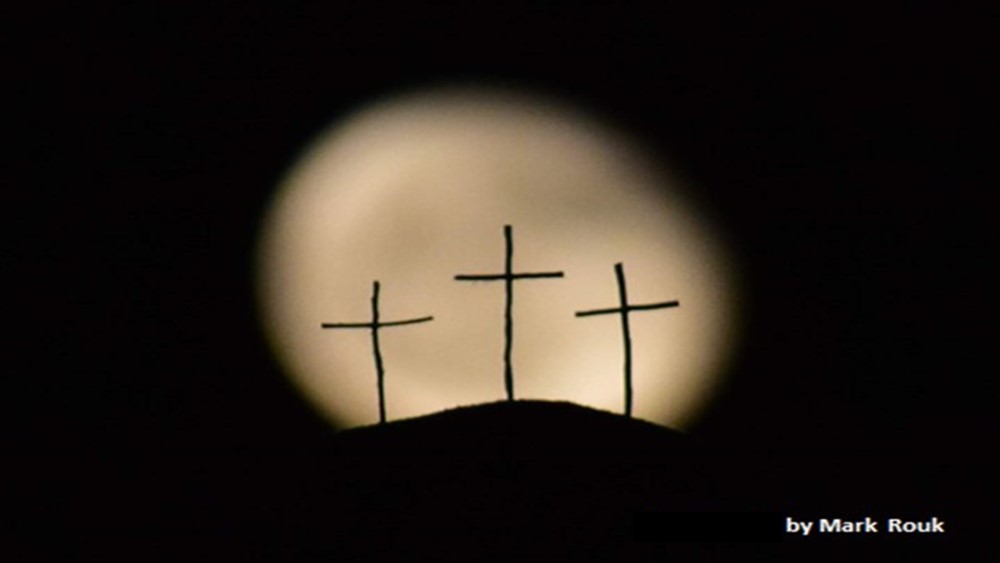
My longtime friend and photographer, Mark Rouk, created this picture a few years ago. It is my all-time favorite Easter picture. I’m guessing he used some simple things like a mound of sand, a few twigs, a drop or two of superglue, a black cloth, and a flashlight. Regardless of what he used beyond his own amazing creativity doesn’t matter—it is the message that his simple silhouette speaks to us.

Defining Easter can be huge or minuscule, depending on your audience. If one is writing a dissertation, it could get deep and complicated really quick. But if it is telling a child what Easter is about, a simpler definition will work. Basically, Jesus loves us so much that He died on a cross for our sins. Enough said, huh? Sometimes a simple Easter is in order for our crazy-busy lives.

I am beyond the age of having kids and even grandkids young enough to hunt Easter eggs. Those were simple days—wonderful days with priceless memories. We dressed our children in the best Easter apparel we could afford—matching shirts and slacks, frocks and frills, shoes, hats and Easter baskets. After the Easter Sunday Morning Church Service, we all made our way to Gramps and Granny Kellogg’s house for lunch. Our sweet Granny Grace’s Easter egg hunts are forever lodged in our hearts. But before the hunt could take place, we gathered in the kitchen where every inch of countertop, the cooktop and the kitchen table were filled with dishes of delicious food. Everyone ate their fill with joy and laughter—while holding off the kids as long as possible to give the teenagers time to hide the eggs. Then the race was on!

I suspect your past Easter Sundays were much like mine. It seems as though they were a lifetime ago. Yet today, I hear my Lord speak priceless words to my heart: “Sarah Jane, slow down and have a simple Easter this year.” I don’t know about you, but I’m in need of a more-simple lifestyle altogether. See if you can relate.

I need to manage my intake of frightening news from around the world—and my best guess is to simply turn it off. I need to worry less about all the corruption in our nation, and simply focus on the good. I need to care less about just the right clothes, shoes and purse, and simply be content with what I have. I need to stop fretting about all the high prices (and God knows they are everywhere), and simply settle for less going, less buying, and less eating. I need to spend less time on frivolous and unnecessary things, and simply do more things that make my Lord, my family, and my friends smile.

I’m sure you’ve heard the K.I.S.S. principle—Keep it simple, S______.” The Lord just gave me the idea to insert the word “Sweetie” as the fourth word in that phrase. So, here’s my advice for a wonderful Easter this year: “Keep it simple, Sweetie!”

A HAPPY AND BLESSED EASTER TO ALL! ~ Sarah Jane

When There Are No Words

[Dedicated to Drew Wright, a true soldier of the cross, who in his darkest moments and deepest sorrow gave glory to God.]


The saying “There are no words” grips my heart. I don’t use it lightly. To me it is an expression of deeper pain than the little inconveniences of life can bring. I did use it recently though, in the days following Christmas Day 2017. An event occurred that brought such deep wounding to my soul that there was nothing else to say.


By all accounts it seemed to be a normal Christmas for Susan and Bill Wright, friends of my family for over 30 years. Since they were expecting their first grandchild, it was sure to be a memorable one as well. What could be more joyous in this joy-filled time of the year than the anticipation of a new baby? Friends rejoiced with them as they waited and celebrated life at every stage.


Their son, Drew, and his beautiful wife, Shannon, were 32 weeks pregnant with Baby Asa James. He was already held tightly in their hearts, but it would be a little longer before they could hold him in their arms. Shannon’s parents had moved from another state to live closer to their first grandchild as well. The entire family was entirely prepared to welcome this special little guy into their lives.


Yet, three days after Christmas something went terribly wrong. There had been no way to prepare for the events that would unfold over the next five days. Drew’s first message on Facebook on December 29th stunned readers:


“Yesterday morning was the hardest day of my life. My best friend and bride, Shannon, passed from this life and entered heaven. We don’t know all the details, but Shannon became unresponsive and was transferred by ambulance to the hospital. She never regained consciousness, but gave birth by C-Section to Asa James Wright.”


The tragic news shocked family, friends, and members of the church where Drew serves as Student Pastor. As the story spread on social media, hundreds and perhaps thousands of Christians began to pray for the family and especially Baby Asa, as his tiny body clung to life. The next Facebook report was a request from Drew:


“Asa is the most beautiful thing and looks just like his momma. Asa is in critical condition and is being treated by doctors for his best chance at survival. I humbly but boldly ask that you would pray. Pray for Claudia and Todd as they lost their daughter, pray for Clayton and Lindsey as they lost their sibling. Pray for my family as Shannon was the daughter and sister they’ve always wanted. Pray for me. I am hurting and broken, but I know God is good. Lastly, pray for a miracle for Baby Asa. He needs our Big God to show up in a big way.”


During the next few days, friends and family surrounded Drew and his infant son with support, comfort and prayers. Because of the Internet, I was aware of what was happening to my friends. A picture of Baby Asa’s tiny body connected to high-tech medical devices with tubes and tape was difficult to take in; yet many prayer partners helped bear the burden of brokenness and grief.


More questions than answers filled our hearts as we continued to call upon God for a miracle. How could this be happening? How will this young man survive such sorrow? How can he declare that God is good in the midst of sheer heartbreak? Is there any purpose anywhere in this tragedy?


On December 31st, Drew’s closest friend and co-worker, Cody Brumley, spoke for many hurting souls:


“In the mighty wake of hurt, we do not seek God’s deliverance from it…we seek God’s presence in it. We run to God bleeding, broken, confused, in disbelief…because nowhere else can we be comforted, answered, loved, and pieced together.”


With each report the heart-wrenching pain grew worse. Another picture showed Drew’s youth group praying and calling out to God in behalf of their leader. A part of me wanted to pull away and know less about this tragedy, yet my efforts to protect myself were futile. We are a body—the body of Christ—and when a part of us hurts, the whole body hurts.


Later that same day, the family was told that the doctors had done all they could for Baby Asa and that they would begin to focus on an end-of-life plan. Once again, Drew informed his prayer partners:


“We still hope for a miracle, but are coming to grips that this may be God’s outcome. Specifically pray that Asa’s short life will have an ongoing ripple effect for the sake of the gospel and God’s goodness in the midst of tragedy.”


A picture surfaced on January 2nd that caused me to finally utter the phrase: There are no words. Drew held Asa close to his heart while others encircled him, laying their hands on his shoulders as he prayed and dedicated his baby son to God. He described those moments like this:


“Today we got to be together to celebrate and dedicate Asa James to the Lord and his story to the glory of God. Sometime in the near future he will most likely breathe his last breath, but in the midst of hurt and pain and questions and fear, I am filled with joy—joy unspeakable that has no words, but just is living in me. God, only you know the impact this young man’s story will have and we trust you with that. God, I trust in you through all of this. I know that Shannon is getting to be what she was designed and destined to be—to be a mom. And today I am thankful for that. Thank you to everyone for your prayers and continued prayers for me, my family, and this community. Pray that God will use this as only He can….”


Drew’s prayer reminds me of a prayer by another young man, who facing something so painful and indescribable, prayed “Nevertheless, not My will, but Thine be done.” Just like his Savior, Drew yielded to the Father’s greater plan. For it is there in the place of surrender, that true joy—the joy he spoke of—can be found.


The following day, January 3, 2018, Asa James Wright slipped away from us and entered heaven where he is held safe in the arms of Jesus and his adoring mom.


When the family announced that a memorial service for Shannon and Asa was to be held the following Saturday, my heart pondered how they would prepare for such an event. The sorrow seemed too deep—the wounds too raw. The faith of many, including my own, had been tested. Would the faith of many stand and not fail?


As I prayed for my friends about what the next few days held for them, the Holy Spirit took me on a journey down memory’s lane. You see, there had been a time in my own life when tragedy had robbed me and my family of a loved one. We too had felt the pain, the emptiness, and the confusion that comes when a loved one is snatched away too soon. In that moment I heard His gentle whisper:


“It was in those dark days when it felt like you were living in a dream and not knowing where you were or how you’d get through the next day or the next hour, when you needed a strength much greater than you own, that something supernatural showed up and carried you.”


Oh, how well I remember what my sweet Jesus had done for me in those dark days. For when there are no words, there is grace.


His grace had held me up. His grace had strengthened me. His grace had gotten me through that dark valley and carried me safely to the other side. I instantly knew that He would do it for my friends as well. And He’s likely done for you, too.


Jesus promises to comfort us in our sorrows, to heal our broken hearts, and to give us peace that passes understanding, if we will trust Him. His Word has never failed His followers and it never will. And so we trust. ~ Janie Kellogg


‘Tis so sweet to trust in Jesus,

Just to take Him at His Word.

Just to know that He has promised,

Just to know “Thus saith the Lord.”

Jesus, Jesus, how I trust Him!

How I’ve proved Him o’er and o’er;

Jesus, Jesus, Precious Jesus,

Oh, for grace to trust Him more! ~ Louisa R. M. Stead


God’s OK with Exuberant Angels

Christmas is full of surprises—those little unexpected moments which delight our hearts and fill our souls to full. It happened a few nights ago at my grandchildren’s Christmas program. Parents and grandparents watched their little ones pull off a spectacular rendition of Jesus’ birth. Every line was not perfectly spoken nor right on cue, but it was magnificent nonetheless.

And the surprise—one little boy (Zane ~ age 5) proved to be a most exuberant entertainer. Dressed in a white tee-shirt, jeans, and a makeshift halo, he stood on the bottom step of the risers that held the angelic choir. This truly adorable angel was poised for a great performance, yet he had one small problem—staying focused. He twitched and twisted with his experiment to see how far it was to the floor below. He swung his left foot off the riser to touch the floor with his tennis shoe; then his right foot—left foot, right foot, over and over it went. Yet, when the choir began to sing another song, he refocused and belted out the words with all his might. A few lines later, his excitement overcame him once again and he amused himself with less important things. The grand finale was his painstaking efforts to pull his arms out of the sleeves of his tee-shirt, leaving us to wonder if the play might end with one half-dressed angel.

The thoughts of this priceless moment bring a smile to my face this morning, yet I wonder if that little boy might reflect us—yes, you and me—during the Christmas season. We know we are supposed to focus on the Greatest Gift Ever Given, yet we get distracted by all the amusing things around us. When something pulls us back to the main thing, we refocus for a time, only to be overcome once again by things of lesser-importance. Like Zane, we do it over and over.

No doubt that little fellow brought delight to the heart of every onlooker, but I believe he also brought delight to the heart of God. Exuberance, energy, excitement—they’re simply part of being a little boy who is cherished and enjoyed. And so are we—cherished and enjoyed by our Heavenly Father. He knows that our exuberance, our energy and our excitement are simply part of being His child—created to live life to the full, to experiment with who we are and what we can do. Perhaps one day we’ll get it right—but until then, here’s a little advice using a few borrowed words from Luke’s account of the original spectacular event that might help us stay focused on the main thing:

In this season of celebration, remember that Jesus coming to earth was indeed good tidings of great joy to all people. So come with haste and find the Savior, glorify and praise God for what is seen and heard, and then go tell everyone what great things God has done. When the hype is over, just ponder all these amazing things throughout the coming New Year. Oh, and don’t forget to look for those little surprises along the way. Christmas is full of them!

 little-lamb

Merry Christmas to all, Janie Kellogg

A Thanksgiving Scene We Will Never Forget

Thanksgiving! Oh, the joy of being with family is almost too precious to describe. The scenes are incredible! We gather around to welcome the newest members; we measure the height of kids growing tall; we recognize personality traits that remind us of a one taken away; and we surely take notice of the graces of life more apparent in each of us. We look on as our offspring learn to be ducks in the bigger pond, and we cherish their successes. Life simply evolves, not without its pain and sorrow, and yet we give thanks.

It’s in scenes like these that the giving of thanks is so appropriate, for in all of them—sacred or sad—we thank the One who gave them to us. His instruction manual tells us to give thanks in everything.1 We not only can, we must; for the Giver of Life does all things well. While we may not always like what is handed to us, He who gives it makes no mistakes.

We can call it acceptance, for that is exactly what it is. Acceptance of what our Heavenly Father has chosen to give to us. I love the story about a little girl who was born both deaf and dumb. When questioned why God would have made her so, she thought for a moment, and then with trembling hands boldly wrote out her response: “Even so, Father, for it seemed good in Your sight.”2

What kind of faith does it take for acceptance like that?  How do such young eyes see such mature truths? And what about us—do we know the meaning of acceptance? Or do we spend our time and energy trying to change that which was given?

Acceptance is what thanksgiving is all about. It is that deep swelling of faith within us that eventually rises to the surface and says, “What God has chosen to give is good and I am thankful for it.” We may not understand it or fully embrace its treasure, but we are still grateful to the God who gave. And why is that—because He can be trusted.

It is comforting to know that one day we will see things more clearly—for we shall see Him as He is, as well as all the things we haven’t understood. We only know in part now and see through a glass dimly.3 But just hang in there—a new day is about to dawn.

The Apostle John wrote about a future scene that is very different from our unexplained ones. Here is a paraphrased glimpse of what he saw just up ahead. Please read it slowly, even out loud, and try to see if you can picture yourself there, in this scene:

I heard what sounded like a mighty shout of a great crowd in heaven, exclaiming, Hallelujah—Praise the Lord! Salvation and glory and power belong to our God! His judgments are true and sound and just and upright. He has judged and pronounced sentence and doomed the great harlot who corrupted and demoralized and poisoned the earth, and has avenged the blood of His servants. And again they shouted, Hallelujah—Praise the Lord! Then the twenty-four elders fell prostrate and worshipped God Who sits on the throne, saying, Amen! Hallelujah—Praise the Lord! Then from the throne there came a voice saying, Praise our God, all you servants of His both small and great. After that I heard what sounded like a shout of a vast throng, like the boom of many pounding waves and like the roar of terrific and mighty thunderpeals, exclaiming, Hallelujah—Praise the Lord! For now the Lord our God, the Omnipotent, the All-Ruler, reigns! Let us rejoice and shout for joy—exulting and triumphant! Let us celebrate and ascribe to Him glory and honor for the marriage of the Lamb has come and His Bride has prepared herself.4

I certainly have my favorite phrases, such as “a mighty shout” (not a timid one); “a great crowd” (God has a big family); “all you servants of His both small and great” (small comes before great, just like Jesus said they would); and “His Bride has prepared herself” (Oh my, we must be ready for the wedding). Are you?

That is a thanksgiving scene we will never forget. I trust that I will see you there! ~ Janie Kellogg

11 Thessalonians 5:18; 2Matthew 11:26; 31 Corinthians 13:12; 4Revelation 19-Selected excerpts from the Amplified Bible.

How to Have a Joyous “No-fuss” Christmas

Who doesn’t want a joyous “no-fuss” Christmas? After all, it’s been a trying year, and I don’t need to remind anyone how perplexed our world is right now. Rather, I think it is a great time to focus on something else, and Christ’s birth is the perfect subject for some refreshing thought. I suspect the world 2000+ years ago was in as much disarray as ours. But Jesus didn’t come to set the political winds from a different direction. He came to cause men to focus on something more important—eternal matters.

Eternal mattersas if eternity matters—and it does! Most of us probably don’t think much about eternal matters except when tragedy strikes. But it came to me that we can turn our thoughts toward eternal matters and set in motion a joyous “no-fuss” Christmas all at the same time. It has to do with the gifts we give to others. These are, however, gifts money can’t buy.

What if, by some rare oddity, we were to give everyone on our gift list the amazing gift of unselfishness—including the selfish ones, the ungrateful ones, the hard-to-get-along-with ones, and even the overbearing ones? Sounds complicated, doesn’t it?

Actually, it’s very simple. We can give them the gift of our self—you know that part of us that Jesus said to deny. We do that by not demanding our way, and instead, yielding to others. That’s it—yielding our right to do or say what we want to do or say. We can keep our gifts under the joyful wrappings of mercy and grace until the confrontation occurs. Then with our simple acts of giving, we discreetly empower others to have it their way. The issue is settled instantly with no fuss. WOW, can you imagine your family Christmas with no fuss!

You and I have this incredible opportunity to share the true message of Christmas—the selfless gift of God’s love to all people. You see, our yielding to others allows us to proclaim that same message of selflessness with our very own lives. Our gifts will make others happy, set them free from past offenses, and literally wipe out tension from our holiday gatherings. And that, my friend, is joyous!

If you think this is some silly idea of cheap gift-giving, trust me, it will cost you much. In fact, it costs so much that many will opt not to have a joyous “no-fuss” Christmas. But we must remember that God’s Gift to us was quite costly—just consider the pain in God’s heart as He yielded up His Son for the selfish, ungrateful, hard-to-get-along-with, overbearing likes of us!

Yielding our lives to God will always cost us, but then we should never give anything that doesn’t cost us something.1 On this Christmas of 2014, I hope we will choose to focus on eternal matters by giving our selfless gifts. It’s a sure-fired way to have a joyous “no-fuss” Christmas!

Merry Christmas ~ Janie Kellogg

1 2 Samuel 24:24

Don’t Miss the “Come” of Christmas

Christmas is upon us once again, and by our very traditions we will come to the manger for a fresh look at Baby Jesus. We will come to view or perhaps participate in musicals, plays, and programs in myriad types of pageantry and merriment. Regardless of their content, they all serve one purpose—to remind us to come and celebrate the Reason for the season.


I love the word “come.” It is a word of invitation and welcome. It speaks to our longing hearts: “You are wanted!” Who doesn’t remember the cherished sound of Mamma calling us to “Come to dinner,” or the joy of friends saying “Come to see us,” or how good it feels when someone invites us to “Come to church on Sunday?” In short, a hearty “Ya’ll come” makes one feel warm all over.


The word come is also used to compel us to do something when there is good reason to do it. A little coaxing might be the better way to describe it. We reach out our hands to a toddler and compelled him or her to “Come to me.” Ah yes, come is a good word!


It is simply impossible to have Christmas without the joyful sound of “O Come, All Ye Faithful.” Who doesn’t love to join in the familiar chorus: “O come, let us adore Him; O come, let us adore Him; O come, let us adore Him; Christ the Lord!” This best-loved hymn by John F. Wade truly compels us to come and worship our Christ.


However we celebrate Christmas this year, we must not miss the come of Christmas. It is tucked within that miraculous Gift given to us by God. And what a Gift it is! The Creator clothed Himself in humanity so He could save us. The magnitude of the humility of God on our behalf is baffling. Why did He do it?


We can find the answer in the come of Christmas, if we will but look closely at the God-child. We think it doesn’t make sense—born to poor and lowly parents, a manger in lieu of a royal cradle, and some very strange onlookers. What was God thinking? Yet, from that humble setting, we can easily hear God’s come: “You—young or old, rich or poor, black or white, educated or uneducated—are welcome here.” There in the cold, dark surroundings of Bethlehem’s mystery, God invites us to “Come, see what I have given you. Come, gaze at incarnate flesh. Come, join the angelic celebration. I want you this much!”


We feel the warmth of God’s come in the age-old story that compels us to believe in the virgin birth, the boy Jesus, the carpenter turned preacher, the miracle-worker, the dying Savior, and the resurrected Lord. It compels us not only to come to the manger, but to come to the cross where we can receive salvation. This Christmas, may we linger long enough at that manger to hear Jesus say, “Come to me, all of you….”


Wherever you find yourself this Christmas of 2013, I wish you all of the blessings that family and traditions have to offer. And whatever you do—don’t miss the come of Christmas!


O Come, let us adore Him! ~ Janie Kellogg

Our Non-traditional Thanksgiving Traditions

On Thanksgiving Day, American families gathered together all across this great and diverse nation to share a meal and give tribute to the One who ultimately provided it. That is simply what we do on this day.


Like other American families, my family has our own Thanksgiving traditions. They are, however, what you might call non-traditional traditions. For more than 30 years, we have celebrated in a unique and personal style in setting, food, and dress.


When asked by strangers how my family celebrates Thanksgiving, I often struggle for words to explain what it is that we actually do. My story is generally met with amusement: “What! No turkey, no dressing, no cranberry sauce!”


It is true nonetheless.  Five generations of non-traditionalists converge on the side of a mountain at a deer-hunters cabin in the pine-covered mountains of Southeast Oklahoma. We arrive on ATVs, Jeeps, and 4-wheel drive vehicles to share in the family fun on this day. We come decked out in camouflage and denim, and everyone who can grow a beard has one. The cabin’s open fireplace assures that everyone and everything will soon smell of smoke.


The food menu hasn’t changed in 33 years—venison, wild turkey, mashed potatoes, beans and cornbread—cooked by the hunters who have camped there for the entire week of deer season. Over the years the menu has grown to include a few traditional side items brought by those who don’t appreciate the non-traditional cuisine (like me); but regardless of what tops the home-built table covered with an orange Oklahoma State University Pistol Pete tablecloth, no one leaves hungry.


When my pastor-son was asked to bless the food, an immediate hush fell across the room. Whether it was kids running to and fro, age-old stories being told and retold, or last minute efforts to put the food on the table, it all ceased for the Thanksgiving prayer. I won’t soon forget my son’s words—they were a testimony of who we are.


In his prayer, my son gave thanks to God for all who had gathered there and for His many blessings to our family during the year. Then he said, “I thank You that someone in this family made the decision many years ago to live godly….” He finished his prayer, but my mind lingered long on the thought, “made the decision to live godly.”


This family was truly blessed to have godly grandparents who blazed the trail before us. They have long departed to heaven, and through the years other family members have joined them there as well. Yet every Thanksgiving, we meet once again to cherish those we can still hug, lavish love on the newest among us, and to remember those who left us this godly heritage.


So what does “live godly” mean anyway? Oh, don’t get me wrong—we are not a perfect family—by any stretch of the imagination. We have our faults, our failures, our sins, and our wounds. Being godly doesn’t mean that we haven’t sinned; it means that we know the Savior who takes away the sin of the world.1 It doesn’t mean that we haven’t made mistakes; it means that we trust in the blood of the Lamb that washes white as snow.2


Deciding to live godly simply means choosing to be like God

We choose to extend grace to undeserving people, because God extended grace to us when we were undeserving.

We choose to forgive those who have hurt us, because God forgave us when we were guilty of hurting others.

We choose to love the unlovable in the world, because God loved us when we were unlovely.


Perfect people—not by a long shot! But we are people who live by our faith in the God who forgives,3 whose mercies are new every morning,4 and who has promised to take us to heaven when we die.5


At the end of the day, a group of full and happy family members who smelled of smoke gathered into a huddle for the annual photo shoot. There we stood—five generations of imperfect godly people enjoying our non-traditional Thanksgiving traditions.  ~Janie Kellogg


1John 1:29; 2Isaiah 1:18; 31 John 1:9; 4Lamentations 3:23; 5John 14:2-3

Thanksgiving Day Fullness

If there is one word that describes the aftermath of Thanksgiving Day, it would be fullness! You know what I’m talking about. We indulge ourselves in a feast of delicious cuisine from roasted turkey with all the trimmings to colorful and delicious sides, and top it off with a smorgasbord of desserts fit for a king. It amazes me that it takes days, maybe weeks, to prepare such a meal—planning, shopping, baking, cooking, and serving. Yet, thirty minutes after our families gather around the table, all we have to show for our efforts are a heap of leftovers, a sink of dirty dishes—and fullness.


In reality, fullness is a two-sided coin. Certainly, it is a result of having enjoyed plenty of the foods we love and that bring back memories of past family gatherings. It is those favorite dishes that excite our taste buds as we linger long, savoring every bite. It’s our encounters with Grandma’s dressing or Aunt Susie’s famous pumpkin pie that inevitably causes us to lose all sense of restraint. After all, it only happens once a year.


But fullness also means that we’ve had plenty of other things as well. The joy of being with family brings an abundance of familiarity to our hearts. We are filled to the brim with gratitude for the fellowship of those we hold dear and who make this holiday warm and inviting. No one tells jokes like Uncle Ben or stories like Grandpa. It matters not that we’ve heard them before—they just never get old. And it is the fullness of life shared with those who mean much that intoxicates us and causes us to repeat the same process year after year. You see, there’s just no place like home with the family.


Did you know that the word fullness in the Bible? The Apostle Paul prayed that we would have it. In Ephesians 3:19, he wrote “that you may be filled with all the fullness of God.” I don’t know what all that entails, but I sure would like to. I suspect, just like the fullness from our Thanksgiving celebrations, it means we have enjoyed God. We’ve lingered long, savoring every bite from His Word. It is our encounters with His Presence that cause us to lose all restraint when worshipping and praising Him.


There is also the fullness we feel when we gather with God’s family. We are filled to the brim with gratitude for the opportunity to be with those we hold dear and who make our fellowship warm and inviting. We love to hear their testimonies and stories of how God has blessed them, and us. It doesn’t matter if we’ve heard the stories many times over—they too just never get old. And yes, it is the fullness of the life of God shared with those who mean much that intoxicates us and causes us to do it over and over. You see, there’s just no place like home with God’s family either.


Regardless of how your family celebrated Thanksgiving, I trust that you came away with fullness, both physical and spiritual. I am personally seeking for all the fullness that Paul prayed for me to have and that God has to offer. I know that “eye has not seen nor ear heard….the things God has prepared for those who love Him” (I Cor. 2:9), but I am doing my best to see them and hear them this side of heaven. Someday, I hope to be filled with all the fullness of God that is possible for a human being. In the meantime, I plan to continue enjoying the fullness that comes from being with God, family, friends, and God’s people. I hope you do too. ~Janie Kellogg