Tag Archives: hope

SOMETIMES I THINK LIFE IS WONDERFUL—BUT NOT ALWAYS

Sometimes I think life is wonderful, filled with happiness, love, and blessings too numerous to count. Yet, I continuously hear of tragic events here at home and abroad that mess with my emotions and unfortunately, with my faith. But we must not let that shape our view of life. However, to empathize with the suffering, it often requires that we have experience ourselves. If you haven’t experienced a tragic loss, count yourself fortunate. Two years ago, I published a book about the tragedies in my life. How about you? Have you experienced a tragic event that messed with your emotions and your faith, as well? 

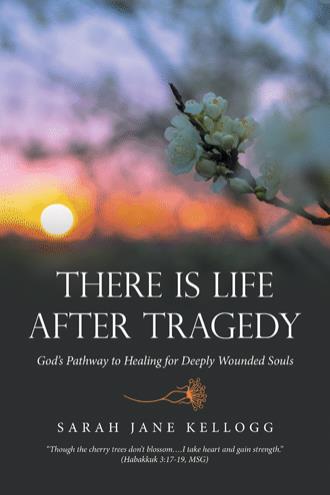
A few weeks ago, I received another book review on my book, THERE IS LIFE AFTER TRAGEDY. It was a review by Premium US Review, and they have now recommended my book. I am sharing a paragraph from that review below. It starts with these words: “This is a book about the power of God to lift one out of the depths of despair.” If that describes you or someone you know, I encourage you to check out my book. The review also states that “Kellogg’s memoir is a fine addition to Christian literature.” Perhaps it could be a fit for your own library.     

PREMIUM US REVIEW: “This is a book about the power of God to lift one out of the depths of despair. Decidedly Christian, the author includes biblical scriptures and motivational quotes from Christian writers that have affected her and helped her overcome the personal trials of her life. Its tone is heartfelt and conversational, pulling the reader into Kellogg’s discovery of the long-held secret of the family’s tragedy. Kellogg offers advice on how to overcome one’s own tragedies through relying on God. Though she writes from a Christian perspective, those of all beliefs will encounter an intriguing and emotional read that will long be in their memories. The author is steadfast in her Christian belief and her faith in a God who desires to heal those who are suffering and can indeed do so. Kellogg’s memoir is a fine addition to Christian literature as well as a wonderful gift to future generations of her own family.”

THERE IS LIFE AFTER TRAGEDY is available at Amazon and all major book retailers. It can also be purchased on my website at http://www.sarahjanekellogg.com. If you are interested, the book also has a Bible Study Guide found on my Website that can be printed and used along with the book. To view the Study Guide, look in the Category section on the lefthand side of the home screen, and then for Bible Studies – There is Life After Tragedy. There you will find 14 posts. The first study guide was the first one posted, so you will need to go down to the beginning post, and then move up from there.

STUDY GUIDE FOR CHAPTERS 13 & 14 ~ THE END AND THE CONCLUSION

A note from the author: When I sit down to write a study guide, I never know where the Holy Spirit is going to take me. I am so excited about where He took me on this one. This message is a matter of life or death. Expect God to speak directly to your heart about the most important decision of your entire life. The conclusion to your story is at stake. ~ Sarah Jane

1.  The Beginning of Our Story (Chapter 13)

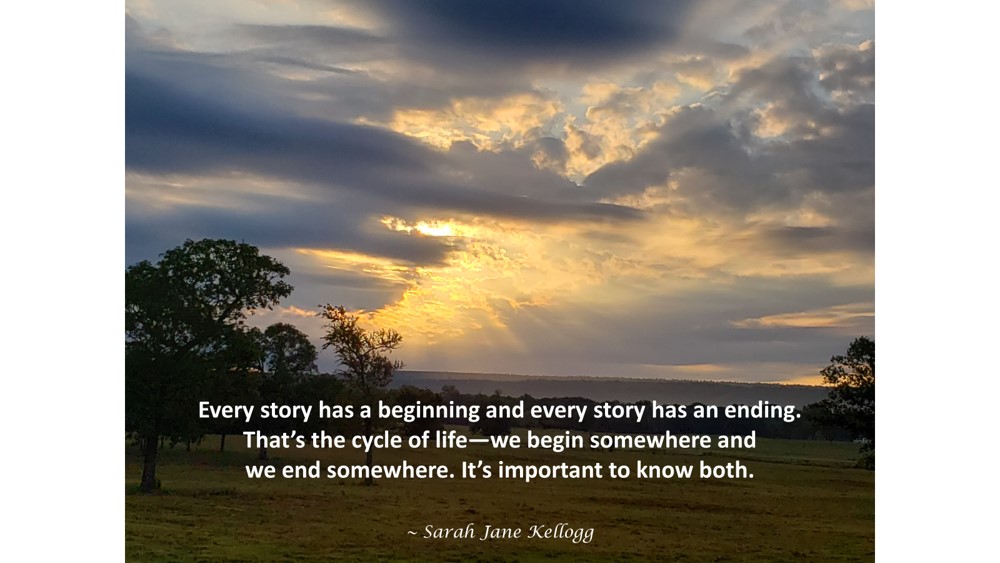
Every story has a beginning and every story has an ending. That’s the cycle of life as well—we begin somewhere and we end somewhere. It is basically the Creator of all life who determines our starting place—what millennium, century, era, year, month and day, as well as what country, nationality, race and family we are born into. He chooses the important details about us as He sees fit, simply because He is in charge of all things beyond our ability to determine. After all, He is God.

However, we do have the capacity to understand that we are the created of God, and Bible tells us just how our Amazing Creator did it. Get ready to be amazed as we read these captivating words by King David in Psalm 139:13-16 (NKJV):

13 For You formed my inward parts;

You covered me in my mother’s womb.

14 I will praise You, for I am fearfully and wonderfully made;

Marvelous are Your works,

And that my soul knows very well.

15 My frame was not hidden from You,

When I was made in secret,

And skillfully wrought in the lowest parts of the earth.

16 Your eyes saw my substance, being yet unformed.

And in Your book they all were written,

The days fashioned for me,

When as yet there were none of them.

Dear one, you have a beginning and it began with God. He chose the big details about you, and He also chose the intricate details about you—the color of your eyes, your hair, your height, and the dimples in your cheeks. You are fearfully and wonderfully made, and God’s works are marvelous. That means YOU are marvelous, because you are one of His works! He also chose and shaped the days you will live upon the earth before one day of your life was even here. He loved you, His created one, so much that He recorded your days in His forever book. How does that knowledge about God make you feel?

_________________________________________________________________

2.  The Middle of Our Story (Chapter 13)

As wonderful as it is, that is not all God has to do with your existence. He was not only involved in the beginning of your story; God is also right smack-dab in the middle of it as well. He knows you through and through, every fiber of your being and every intent of your heart and mind because He’s the One who made you the way you are. King David spells it out in the same chapter in Psalms. Read these incredible words slowly to grasp their meaning. Psalm 139:1-6 (NKJV).

1 O Lord, You have searched me and known me.

2 You know my sitting down and my rising up;

You understand my thought afar off.

3 You comprehend my path and my lying down,

And are acquainted with all my ways.

4 For there is not a word on my tongue,

But behold, O Lord, You know it altogether.

5 You have hedged me behind and before,

And laid Your hand upon me.

6 Such knowledge is too wonderful for me;

It is high, I cannot attain it.

In other words, the Master Sculptor knows every word you speak and every thought you think. God knew where David was every moment of the day, whether he was sitting up or lying down. David said that God had a hedge around him, and was in front of him and behind him. In fact, David stated that God’s very hand was upon him. David described that as a wonderful thing.

I wonder why David thought that was a wonderful thing, since most of us like our privacy. I believe it was because David knew that the God who created him was on his side! God was for him and not against him. David recognized that having the most powerful force in the universe watching over him and looking out for him 100% of the time was a huge plus in his favor. How about you? Do you know that God is on your side? _______ That God is for you and not against you? ________ Explain if that makes you feel good or not-so-good.

__________________________________________________________________

__________________________________________________________________

3.  The End of Our Story (Chapter 13)

At the end of my book, There Is Life after Tragedy, I describe how all of my relatives who were not Christians at the time of the tragedy eventually came back to the God of their parents. “Not one of them dared to miss heaven” because they grew up being taught that God was real and that God loved each one of them. I don’t know where you are in your journey, but you need to understand that while you didn’t have any say in where, when, and to whom you were born, and that God watched you all the years in the middle of life, protecting, drawing, and tugging at your heart, whether you wanted Him to or not—you do have a say in the end your earthly life. We are going to look at one more passage of scripture that could be the most valuable verses in all of these many weeks of studying the Bible. It is found in that same chapter—Psalm 139:7-12 NKJV

7 Where can I go from Your Spirit?

Or where can I flee from Your presence?

8 If I ascend into heaven, You are there;

If I make my bed in hell, behold, You are there.

9 If I take the wings of the morning,

And dwell in the uttermost parts of the sea,

10 Even there Your hand shall lead me,

And Your right hand shall hold me.

11 If I say, “Surely the darkness shall fall on me,”

Even the night shall be light about me;

12 Indeed, the darkness shall not hide from You,

But the night shines as the day;

The darkness and the light are both alike to You.

What we glean from these verses is that the God who made you will not let you slip away from Him without trying over and over to get your attention. In fact, you will not be able to get away from Him. You cannot run far enough to get out of His reach. Isn’t it just remarkable to think that this mighty, powerful God loves His creations that much! He wants you to spend eternity in Heaven with Him, and He will go to all lengths to bring you to Himself. He cares more than you have ever imagined possible. Today He longs for you to stop running and let Him catch you. If this describes you, have you ever thought about these two questions:

“What have I got to lose, if I give my heart to God?” _________________________________________________________________

“What have I got to lose, if in the end I have not responded to God’s love for me?”

__________________________________________________________________

A loving God patiently awaits your answer. You alone have control over the end of your story and where you will spend eternity. Not God. Not anyone. Only you.

4.  The Conclusion of Our Story (Chapter 14)

I tend to think of a conclusion as the wrap-up of an event or process. It is when all is said and done, or when it’s over and the results are in. In reality at the end of life, a conclusion means one thing: Where we will spend eternity. The opportunity to change our mind is past. The ability to think again has disappeared. The chance to have overs is forever gone. We will all have one of two conclusions: Life forever in heaven with a God who has loved us since the beginning, or life forever in a place of darkness away from God.

Stop for a minute, turn off the noise, lean back and relax. Now close your eyes and take in a long deep breath of air. Allow your mind to slip into neutral as best you can, and then ask yourself these questions: Have I ever stopped long enough while living this life God has given me to realize where it came from? Have I ever considered that there is a Creator who intentionally made me the way I am? Have I ever thought that I am the object of His love, His hope, and His joy? Be honest—have I believed these statements or do I believe what I’ve only heard about God? If so, was it from a reliable source?

__________________________________________________________________

What else would your Heavenly Father have to tell you to make you believe how excited He is over you? More scriptures? The Bible is full of words that describe His love for you. You are His magnificent creation. His love is reaching for you. His love is encircling you, desiring to capture your attention. He has been looking for you for your entire life. He has been calling out to you and chasing you down with His blessings. He cares deeply for you. And He longs to reveal His love to you—if only you would welcome Him into your life.  

How about today—right now—would you turn your heart toward the Lover of your soul? No one has ever loved you like Jesus Christ loves you. No one else died for you—in your place—except Jesus. No one else can offer you eternal life in heaven. There are only two options when you die: one is a wonderful choice, and the other is the worst conclusion to any life. My prayer for you is that right now you will pray the following prayer and ask Jesus to come into your heart and save you. It will be the best decision of your life. I promise.

Prayer: Dear Heavenly Father, my heart feels something stirring inside. I have never actually given you the opportunity to catch me, but I’m tired of running. My plans haven’t worked out so well, so I would like to try your plan. I am sorry for my sins and my bad choices. I ask you to forgive me and give me another chance. I invite you, Lord Jesus, to come into my heart and change me into a new person. I want to spend eternity with you in heaven. Thank you for saving me right now. In Jesus’ Name I pray. Amen.

If you just prayed this prayer, please leave me a comment under Study Guide for Chapters 13 & 14 on my website: www.sarahjanekellogg.com and I will respond.

STUDY GUIDE FOR CHAPTER 10 ~ THE TRIUMPH

A note from the author: You will find this chapter packed to the brim with powerful statements. In fact, it could be the most impactful and revealing chapter in my book. How fitting it is to be called “The Triumph!” Don’t dare to miss its message. ~ Sarah Jane

1.  Tragedy Demands A Triumph

If there was “the tragedy” that happened in my family (and there was), then there also has to be “the triumph,” or else the word “the” is misleading. The title alone leads us to believe that triumph is possible. But it was not only possible—it became a reality.

Perhaps triumph can be gained only by those who make it theirs—those who claim it and possess it. But before we come to any conclusions, let’s look at where this word triumph is used in the Bible.

2 Corinthians 2:14 (NKJV) ~ Now thanks be to God who always leads us in triumph in Christ, and through us diffuses the fragrance of His knowledge in every place.

Did you catch that—the part about God always leading us in triumph in Christ?” And just where might God be leading us to? Let’s try another one of the Apostle Paul’s famous statements for the answer.

1 Corinthians 15:55-57 (NKJV) “O Death, where is your sting? O Hades, where is your victory?” 56 The sting of death is sin, and the strength of sin is the law. 57 But thanks be to God, who gives us the victory through our Lord Jesus Christ.

Here we see God as the Giver of victory—which sounds to me like a first cousin to the word triumph—and it is given to us through Jesus. Let’s check one more verse.

Romans 8:37 (NKJV) ~ Yet in all these things we are more than conquerors through Him who loved us.

Now let’s gather up the most powerful words from these three verses: “leads us in triumph,” “gives us the victory,” and calls us “more than conquerors.” These are all promises of where God leads us, what God gave us, and what God calls us through His Son, Jesus Christ! To condense it even further, in God’s eyes we are seen as: triumphant, victorious conquerors! WOW! Since they are already given, that means we already have them. They are ours for the taking! So of course there is “The Triumph” in our story.

Since I am on a wordsmithing roll, I’m going to take it yet another step: There is not only life after tragedy, there is life after your tragedy. There is also triumph after your tragedy, and victory after your tragedy. Therefore, you are a triumphant, victorious conqueror after your tragedy! Hallelujah!

2. A Deeper Cause

You will find this sentence on page 86 of my book: “Our healing has a greater purpose than to simply stop our pain.” Doctors tell us that pain is a good thing. Why? Because pain tells us that something in our body isn’t normal.

God allows pain in our lives for the same purpose—most generally to point our focus to eternal matters. What He cares most about us is our souls. I suspect that most of us—or ALL of us—can say that pain in our bodies or hearts have been helpful to God in getting our attention. In short, God is more interested in where we will spend eternity than in our comfort here on earth.

Pain can cause us to turn to God—actually run to God—in desperation. When we finally turn to Him spiritually, our pain level will begin to subside because He is the Healer of the whole person—body, soul and spirit. It is in turning to God to heal our lives both inside and out, that we discover the pathway to wholeness and freedom from our pain.

Have you (or someone you know) suffered from a great loss, and their inward pain of heart and soul led them to turn to God? ___________

Did you (or they) find freedom from pain? ________________ Briefly describe that story.

__________________________________________________________________

__________________________________________________________________

__________________________________________________________________

3.  Is a Comeback Possible for You?

One of the emotions I remember so well after the loss of my husband was the feeling of hopelessness that a comeback would never happen for me. Can you relate? __________ This next statement is one of those powerful truths from that chapter in my book. Read it carefully.

“How do deeply wounded people make a comeback? They do it one step at a time, with the help of their Creator.”

To make a comeback, there are necessary steps we must take, even if we don’t feel like it. First of all, we have to believe that triumph can be ours. If I had never taken steps to encourage my faith that I could make a comeback, triumph would not have been mine. Here are some things we can do to start the process of coming back from loss.

1) We get out of bed every day to face our new and different world.

2) We put one foot in front of the other to propel ourselves forward.

3) We have to make a conscious effort to stop listening to the lies of the enemy; in fact, you may have to change friends. See if you can add more to my list:

__________________________________________________________________

__________________________________________________________________

__________________________________________________________________

I learned from my own personal grief that recovery is always a choice. Do you believe this? ____________ Why or why not?

__________________________________________________________________

__________________________________________________________________

Grief is a healthy response to the hard places in life. We need to grieve in order to properly process our loss. No one should be criticized about the way they grieve or how long they grieve. Grief is a personal choice. Likewise, recovery is a choice.

Do you know someone who has not turned loose of grief? ______________ Do you think their choice has been a good one? ______________ Why or why not?

__________________________________________________________________

__________________________________________________________________

4.  What Can We Do with Our Scars?

Another thing that lingers long even after we recover is our scars. Scars are a clear reminder of our loss and our pain. Do you see scars as a positive or a negative?

Why?  (This is a matter of personal preference, and neither answer is wrong.)

__________________________________________________________________

__________________________________________________________________

__________________________________________________________________

When I think of scars, I generally think of Jesus’ nail-pierced hands and feet. Would you say that Jesus looks at His scars positively or negatively?

__________________________________________________________________

Do you think Jesus’ scars remind Him of the excruciating pain He experienced while on the cross and says: “You weren’t worth that pain?” ______________

All I can say in response to that question is a great big “NEVER!” Jesus knew the price up front that He would have to pay in order to save us from the eternal penalty of death, and He chose to do it anyway.

I believe when He looks at His own scars, He thinks that you—every last one of you—were worth every ounce of pain He felt and every drop of blood He shed. I believe He smiles at His scars as He thinks of us—His rescued brothers and sisters!

5. Who Makes the Decision?

In my book I describe the life of a man named Charles Krauthammer. For years Charles was a news commentator on the Fox News Channel and sat at the news desk in a wheelchair. One would hardly notice his chair, unless you knew his story. While attending college, Charles was injured in a diving accident. Yet, in spite of his disabilities, he decided to finish college and then went on to become a doctor. Later, he chose to enter journalism where he won a Pulitzer Prize for his work. A few days before Charles died in 2018, he wrote to his friends and colleagues that he had no regrets—because he had lived the life he intended.

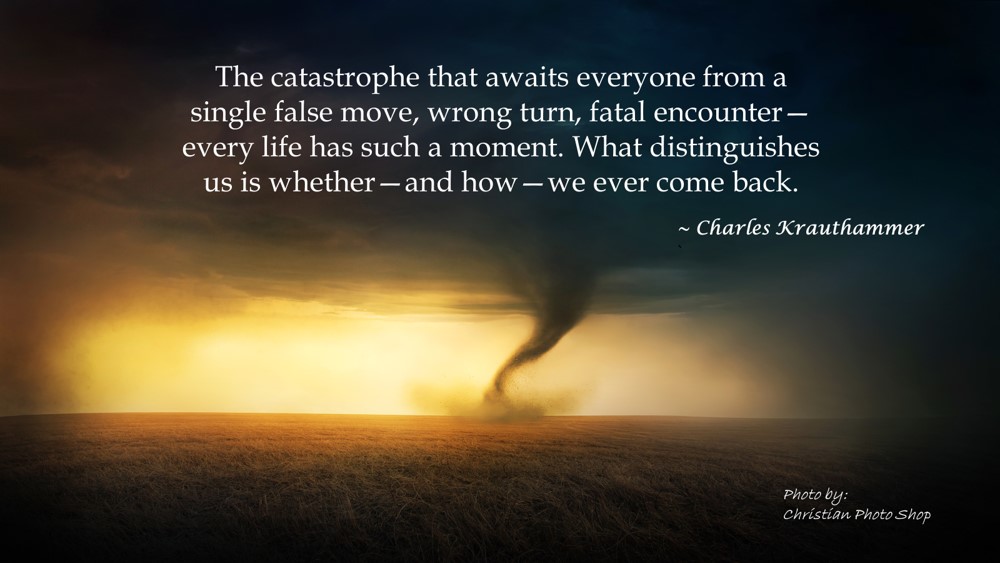
Without a doubt, Charles Krauthammer made a decision after suffering a life-altering tragedy—to live his life just as if the tragedy never happened. Here is a quote from this remarkable man, that gives us pause: “The catastrophe that awaits everyone from a single false move, wrong turn, fatal encounter—every life has such a moment. What distinguishes us is whether—and how—we ever come back.”

What about us? Have we made a decision to live as if our tragedy never happened? Have we decided to come back from tragedy and move forward? If not, then it seems to me that we have a decision to make, and no one can make it for us. I believe God sees our hearts and longs to help us do that very thing. He is fully committed to helping us do it—but He can’t and He won’t without our decision. What is your answer to one of the most important questions in your entire life? Write your thoughts, feelings, and commitments below.

__________________________________________________________________

__________________________________________________________________

__________________________________________________________________

Prayer: Dear Heavenly Father, I have been dragging my feet on getting back to living. I have felt sorry for myself; blamed others; maybe even you because my life has been altered. I want to move forward, but I totally need your help to do it. I now ask for your help, and I commit to taking whatever steps I need to take. Today is my day to start living again. In Jesus’ powerful Name I pray. Amen.

STUDY GUIDE FOR CHAPTER 8 ~ THE PURPOSE

A note from the author:  If there is one study guide that has the potential to reach into your broken heart and bring healing to your life—it is this one. Please read it closely and intently. Please watch the special video section. I am praying for you to find the answers you have long sought after. This could be your day for wholeness! ~ Sarah Jane

1.  Can There Be Purpose in Tragedy?

Finding purpose is perhaps the hardest thing to handle after a tragedy. We would likely think: What purpose could this tragedy possibly have? Obviously, there is no good thing anywhere to be found here.

Yet, we know that absolutely nothing misses the eyes of God. He is the only One who can see over the horizon and know where this event can stir the hearts of people. His greatest goal is always to get the attention of the lost among us—the eternally lost members of mankind.

Those who have been closely impacted by a tragedy will struggle to see any good from it whatsoever. However, God’s Word tells us what was meant for evil, He can use for good. In this lesson we will take a close-up look at the tragic story of young Joseph and see what we can learn about God’s ability to use tragedy for good. This concept is sure to stretch us—but that’s okay. God is always stretching us to make us more like Jesus.

2. The Tragic Story of Joseph

The story of Joseph, son of Jacob, grandson of Issac, and great grandson of Abraham, is told in Genesis Chapters 37 through 50. It is a story of jealousy, revenge and evil, but also a story of kindness, forgiveness, and love. Joseph was the favorite of the twelve sons of Jacob. His father loved him very much, and all the others knew it. To make things worse, Joseph began having spiritual dreams about who he would someday be, yet bragging to his brothers didn’t work out so well. In hatred and spite, they wanted to kill him; but one brother talked them into sparing his life and selling him to slave traders.

Young Joseph found himself in the land of Egypt as a slave, far away from his beloved-child status. Yet, everything he touched worked in his favor—until one day it didn’t. Still, Joseph never forgot His God. He landed in prison for many years because of false accusations against him. Yet, regardless of Joseph’s living conditions, God never changed His plan to use him for a big assignment—to save the known world from famine. The very dreams Joseph had been given as a young lad eventually became reality. Joseph was made the Prime Minister of Egypt, where he oversaw a seven-year plan to store up food for a seven-year famine.

The tragedy of Joseph’s life included being separated from his beloved father and only full-blood brother, Benjamin, and living the life of a slave. After he was thrown in prison, he likely thought his life was doomed. One would think that everything optimistic about Joseph’s future had been thwarted. But God always has another plan even when it seems that the great enemy of our soul has won.

After the death of Joseph’s father, his brothers feared that Joseph would take revenge on them and their families. That is where we will pick up the story in Genesis Chapter 50:15-21 in the New Living Translation.

15 But now that their father was dead, Joseph’s brothers became fearful. “Now Joseph will show his anger and pay us back for all the wrong we did to him,” they said. 16 So they sent this message to Joseph: “Before your father died, he instructed us 17 to say to you: ‘Please forgive your brothers for the great wrong they did to you—for their sin in treating you so cruelly.’ So we, the servants of the God of your father, beg you to forgive our sin.” When Joseph received the message, he broke down and wept. 18 Then his brothers came and threw themselves down before Joseph. “Look, we are your slaves!” they said. 19 But Joseph replied, “Don’t be afraid of me. Am I God, that I can punish you? 20 You intended to harm me, but God intended it all for good. He brought me to this position so I could save the lives of many people. 21 No, don’t be afraid. I will continue to take care of you and your children.” So, he reassured them by speaking kindly to them.

Did you notice how Joseph described his life that had certainly gone amuck? Did you hear any resentment or revenge in his response to his guilty brothers? Did you hear any words of bitterness in his assessment of the lemons in life that he had been handed? You’ve probably heard the statement about lemons: “When life gives you lemons, make lemonade.”

What did Joseph do with his lemons?

__________________________________________________________________

What do you think his brothers deserved?

__________________________________________________________________

3. Finding Purpose in Hard Things

I do not intend to make light of tragedy in any way, because there’s nothing light about it. The tragedies in Joseph’s life could have caused years of hatred for his brothers; an incessant desire to get revenge; and a permanent root of bitterness. Let’s also remember that because of Joseph’s high position in Egypt, he had the power to have all of his brothers executed. But that is not what Joseph did.

Joseph took the exact opposite route in dealing with his lemons: he looked to God. He recognized that God had good intentions for all of the intense training he encountered as a slave. He literally said, “He (God) brought me to this position.” Lastly, Joseph added purpose to his pain and suffering: “So I could save the lives of many people.”

Do you think that Joseph was just another superhero in the Bible, or do you think all of God’s chosen ones have the same opportunity to make the choices that Joseph made? Explain your answer.

_________________________________________________________________

_________________________________________________________________

Finding purpose in a tragedy is difficult to say the least, but it is doable. Yet, it won’t come to us unless we have this one thing: a change in perspective. Having a change in perspective basically depends on how we process what happens to us. For instance, it isn’t uncommon for a person to accept a victim mentality about their life’s lemons. They truly see themselves as a victim.

It’s somewhat like Eeyore in the Winnie the Pooh stories. Eeyore was an old grey stuffed donkey who was down about everything—the weather, the seasons, the neighbors, and even his friends. His pessimistic, gloomy disposition showed up in every conversation he had. And if we are not careful, we can have the same perspective about life as Eeyore had.

But I have good news for every one of us—be it those who survived tragedy or those who are simply disillusioned with life. God did not do any of the things that caused your tragedy or your unfortunate circumstances. God is good all the time, and we can take that to the bank. In fact, if God is good all the time, then bad things that happen to us cannot be a result of God being not good. That’s impossible! Yet, the enemy of our souls continually thinks up bad things to do to us, just like Joseph’s brothers did.

Fortunately, in God’s Word we find out what is really happening to us, as well as what we can do about it. Let’s look at 1 Peter 5:8-9 NLT ~ “Stay alert! Watch out for your great enemy, the devil. He prowls around like a roaring lion, looking for someone to devour. 9 Stand firm against him, and be strong in your faith. Remember that your family of believers all over the world is going through the same kind of suffering you are.”

Did you get that? You are not the only one suffering at the hands of the enemy! And there is something you can do about it. We are to stand firm, be strong, and use our faith! God’s Word is energized by the power of the Holy Spirit and when we claim it for ourselves and walk in it, we can have the same overcoming perspective as Joseph had. He moved from being a victim to being a powerful witness for the goodness of God!

My paraphrased version of Joseph’s perspective goes like this: “It’s okay what you guys did to me. You meant it for evil, but hey, God had a greater purpose for my life. He used your ill-treatment to train me and prepare me for the 2nd highest job in the known world, in order to save the lives of many people!” Read that again.

4.  Special Video Section:

Dear ones, if you can grasp the power available to you through God’s Word and His great love for you, you can start to see your tragedy in a whole new light. Below is a link to a five-minute video by Joyce Meyer, that is one of the greatest testimonies of a modern-day application of God’s power that I have ever heard.

I have read about and watched Joyce’s testimony about being sexually abused by her father repeatedly as a child and a teenager. Yet this particular video takes us beyond her pain and opens to us the mighty work of restoration that God performed in her life. I include it not only as hope for those who have suffered at the hands of another person, but also for those who have thought God handed them lemons and they are stuck with them. But God didn’t do it, and we are never stuck with what the devil intended for evil. Be sure to watch it to the end. The following link can be clicked on or copied into your browser.

Prayer: Dear Heavenly Father, you and you alone know the deepest hurts in my heart. I have suffered for many years and feared that I can never be free from this pain. But today, I see a light at the end of the tunnel that I have never seen before. For the first time, I have hope that you see me and love me, and you have a plan to restore my life. I ask you to do just that—today. Send me the person or people that can help me start toward the new pain-free future that you have planned for me. I thank you now for this powerful new truth in my life. In Jesus’ Name I pray. Amen.

STUDY GUIDE FOR CHAPTER 7 ~ THE SURVIVORS

A note from the author: Few people realize what is waiting for them days, weeks, months, and even years after a loss. It’s strange how others attend the funeral and then quickly move on with their lives. That is not the case for close family members. To survive they need fresh air, fresh surroundings, and certainly, fresh hope. So, let’s tackle loss and loneliness with some fresh ideas. ~ Sarah Jane

1.  Defining A Survivor: What does that look like?

“A person alive after an event in which others have died,” is how the Oxford Dictionary defines a survivor. The word alive is quite an optimistic description of a person who feels so much not alive after a tragic event. It is true when someone we love dies, our emotions can range from total numbness to having no desire to live, or perhaps even considering suicide. I think rather than using the word alive, the person could better be defined as “someone still breathing,” and even that is a bit of a stretch.

The word aloneness brings its own mixed bag of emotions as well. Survivors often crave to be alone; yet in attempting to live again, they find themselves alone much of the time. That is where God’s promise to never leave us or forsake us is a powerful antidote to the rejection one feels who has survived, even though they may wish they hadn’t. Antidote means a cure, a remedy, or a solution. Isn’t that we are searching for—a way to break the grief and sorrow off our lives? How would you describe what needs to be broken off your own life—the thing for which you most need an antidote? (This doesn’t have to be about the loss of a loved one.)

__________________________________________________________________

__________________________________________________________________

2. We Are Not Alone In Our Grief

For our scripture reading, we are going to start with a story found in the book of Ruth, a small four-chapter book sandwiched between Judges and 1 Samuel. Let’s begin with Ruth 1:1-5.

Ruth 1:1 ~ In the days when the judges ruled in Israel, a severe famine came upon the land. So a man from Bethlehem in Judah left his home and went to live in the country of Moab, taking his wife and two sons with him. 2 The man’s name was Elimelech, and his wife was Naomi. Their two sons were Mahlon and Kilion…. And when they reached Moab, they settled there. 3 Then Elimelech died, and Naomi was left with her two sons. 4 The two sons married Moabite women. One married a woman named Orpah, and the other a woman named Ruth. But about ten years later, 5 both Mahlon and Kilion died. This left Naomi alone, without her two sons or her husband.

For starters, do you see why Naomi might feel “not alive” and “alone?” How does one lose their entire family in just five short verses? Certainly, Naomi had a full license to grieve, feel sorry for herself, and have no desire to live. But a child of God is never without hope. God always has a plan and Noami’s story will prove that to us.

The full story is contained within the four chapters of the book of Ruth, and it is well worth reading. However, I am going to point out a few choice verses that helps us gain an understanding of the pain and grief that gripped Naomi’s heart.

Ruth 1:6-13 ~ Then Naomi heard in Moab that the Lord had blessed his people in Judah by giving them good crops again. So Naomi and her daughters-in-law got ready to leave Moab to return to her homeland…. 8 But on the way, Naomi said to her two daughters-in-law, “Go back to your mothers’ homes….9 May the Lord bless you with the security of another marriage”.…13 Things are far more bitter for me than for you, because the Lord himself has raised his fist against me.”

Orpah takes Naomi’s advice and returns to her family back in Moab. But Ruth commits to going on to Judah to be Naomi’s family and serve Naomi’s God.

Ruth 1:19-21~ So the two of them continued on their journey. When they came to Bethlehem, the entire town was excited by their arrival. “Is it really Naomi?” the women asked. 20 “Don’t call me Naomi,” she responded. “Instead, call me Mara, for the Almighty has made life very bitter for me. 21 I went away full, but the Lord has brought me home empty. Why call me Naomi when the Lord has caused me to suffer and the Almighty has sent such tragedy upon me?”

Is it just me, or do you hear hopelessness in Naomi’s words? What else do you hear?

__________________________________________________________________

__________________________________________________________________

__________________________________________________________________

I truly feel her grief and believe that she is burdened down with it. Could we safely say that Naomi needs an antidote? __________

As you finish reading this beautiful story of Naomi and Ruth, you will discover that God absolutely had an antidote awaiting Naomi in her homeland. God’s plan included a family-redeemer or kinsman-redeemer named Boaz who buys the land owned by Naomi’s husband from her. Along with redeeming the land, he was required to marry Ruth. Naomi soon has a grandson, Obed, sitting on her lap that she cared for as her own. He grew up to become the father of Jesse, who was the father of King David. In short, Naomi’s grandson was in the royal lineage of Jesus. I think it is safe to say that Naomi was indeed a survivor!

3. What To Do When God Goes Silent

The devastation that occurred in Naomi’s life may have been told in five short verses of scripture, but her story played out in real time as years upon years of sadness, sorrow and lack of hope. Perhaps our trials in life will never be anything like what Naomi endured, but we will have our share because Jesus Himself told us clearly, “In this world you will have tribulation.”

For me personally, I struggle the most when it seems as though God goes silent and I am left to handle things by faith and trust alone (as if those two aren’t mighty weapons in our arsenal). I suppose that we all prefer for God to hold our hand, put His arm around our shoulder and say, “Come to me and I’ll fix all of this for you.” But that is not how it works in this world. Faith and trust are great companions, yet they don’t always include the warm fuzzy feelings we’d like to have.

If you are a fan of the Devotional Book “Jesus Calling,” by Sarah Young, you are well acquainted with reading words that are written as though God Himself said them. I want to use that same “first person” approach with the following paragraph. My goal is that you can hear what God would say directly to you about feelings.

“My Child, feelings come and go. They are subject to good days and bad days, sunshine and rain, life and death, wealth and poverty. Yet, My Word is not subject to anything. My Word will stand forever and you can trust it throughout all eternity. So don’t try to tie me down to responding to your feelings. I respond to those who know My name, hear My voice, and trust that I will do what I say I will do. Feelings are not a part of the walking-by-faith process. Trust must always be your response, even to My silence. We can work together with that combination: My trustworthiness and your trust in Me.” ~ God

I hope that this paragraph spoke clearly to your heart, because there are powerful truths within it. Feelings, especially good ones, have their place; yet they are never a good measuring stick for how God deals with His children.

4. Becoming A Survivor Is Always a Choice

The most helpful thing we can do for someone struggling to survive the aftermath of tragedy (including yourself) is to give them hope. We must all have hope, even in small things. Hope that the sun will come up tomorrow. Hope that this too will pass. Hope that God cares about me. God’s Word is full of hope and we can share it in tender, loving ways. We can all encourage one another with hope.

God doesn’t call all of us to be counselors, but He does call all of us to be encouragers. 1 Thessalonians 5:11 says, “So encourage each other and build each other up….” Being an encourager is our role in the lives of our brothers and sisters in Christ. We can also encourage ourselves, which will be covered in Chapter 9.

Giving hope and encouragement doesn’t have to be expensive, because in reality, what hurting and lonely people need most is love, friendship, and compassion. Understanding someone’s condition of loss and loneliness is the greatest gift you can ever give to them. And, remember to give yourself some compassion, too!

List some of the ways we can bring hope and encouragement to each other. While prayer is certainly a good answer, let’s try to think outside the box of our ordinary ideas. Remember, God has a reputation of goodness. Psalm 23:6 says, “Surely goodness and mercy shall follow me all the days of my life….” What might you pull out of God’s storehouse of good things to give to a lost and lonely soul? Who knows, your fresh idea might trigger an antidote for their life!

A few examples are listed here, but add your own thoughts and ideas to the list.

1) Take a depressed friend for a day out, or order lunch for the two of you and take it to their home to share it together.

2) Invite a lonely friend to share in your own family’s holiday celebration. They may not come, but at least they will have felt included.

__________________________________________________________________

__________________________________________________________________

__________________________________________________________________

Whatever you do, do it with the love of Jesus as your source. You can’t go wrong when you listen to the voice of the Holy Spirit and include Him in your plans.

If you are the person who is hurting or lonely, encouraging another hurting or lonely friend can be the best therapy you could ask for. Try it, and see what the Holy Spirit does in YOU. And when you give hope and encouragement to others, you take being a survivor to a whole new level!

Prayer: Heavenly Father, I am so thankful that you care deeply about me and my needs, as well as all hurting people everywhere. I want to be a survivor, and today I choose to be a survivor. I want to be an encourager to others, and I ask your Holy Spirit to guide me as I develop a plan to reach out and help someone else. In Jesus’ Name, I pray. Amen.

A SIMPLE EASTER

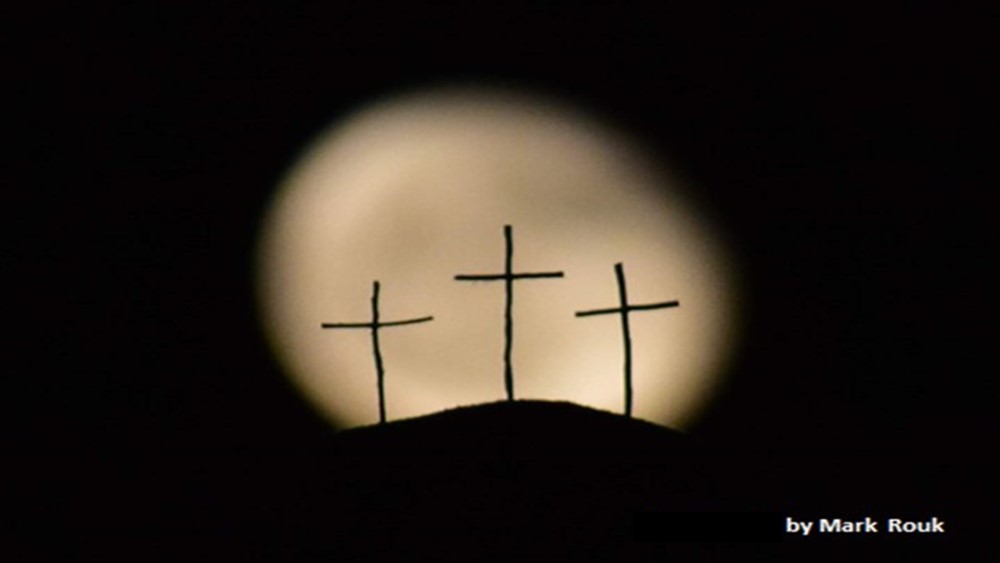
My longtime friend and photographer, Mark Rouk, created this picture a few years ago. It is my all-time favorite Easter picture. I’m guessing he used some simple things like a mound of sand, a few twigs, a drop or two of superglue, a black cloth, and a flashlight. Regardless of what he used beyond his own amazing creativity doesn’t matter—it is the message that his simple silhouette speaks to us.

Defining Easter can be huge or minuscule, depending on your audience. If one is writing a dissertation, it could get deep and complicated really quick. But if it is telling a child what Easter is about, a simpler definition will work. Basically, Jesus loves us so much that He died on a cross for our sins. Enough said, huh? Sometimes a simple Easter is in order for our crazy-busy lives.

I am beyond the age of having kids and even grandkids young enough to hunt Easter eggs. Those were simple days—wonderful days with priceless memories. We dressed our children in the best Easter apparel we could afford—matching shirts and slacks, frocks and frills, shoes, hats and Easter baskets. After the Easter Sunday Morning Church Service, we all made our way to Gramps and Granny Kellogg’s house for lunch. Our sweet Granny Grace’s Easter egg hunts are forever lodged in our hearts. But before the hunt could take place, we gathered in the kitchen where every inch of countertop, the cooktop and the kitchen table were filled with dishes of delicious food. Everyone ate their fill with joy and laughter—while holding off the kids as long as possible to give the teenagers time to hide the eggs. Then the race was on!

I suspect your past Easter Sundays were much like mine. It seems as though they were a lifetime ago. Yet today, I hear my Lord speak priceless words to my heart: “Sarah Jane, slow down and have a simple Easter this year.” I don’t know about you, but I’m in need of a more-simple lifestyle altogether. See if you can relate.

I need to manage my intake of frightening news from around the world—and my best guess is to simply turn it off. I need to worry less about all the corruption in our nation, and simply focus on the good. I need to care less about just the right clothes, shoes and purse, and simply be content with what I have. I need to stop fretting about all the high prices (and God knows they are everywhere), and simply settle for less going, less buying, and less eating. I need to spend less time on frivolous and unnecessary things, and simply do more things that make my Lord, my family, and my friends smile.

I’m sure you’ve heard the K.I.S.S. principle—Keep it simple, S______.” The Lord just gave me the idea to insert the word “Sweetie” as the fourth word in that phrase. So, here’s my advice for a wonderful Easter this year: “Keep it simple, Sweetie!”

A HAPPY AND BLESSED EASTER TO ALL! ~ Sarah Jane

STUDY GUIDE FOR CHAPTER 2 ~ THE GATHERING

A note from the author: You do know that God is always moving us forward in life and in knowing Him—right? It’s a wonderful journey, especially when we anticipate the powerful Holy Spirit working in us. This lesson is packed full of good things—the very things you have been looking for. So, let’s get started! ~ Sarah Jane

1.  Finding a Place of Freedom

To give us a point of reference for this chapter, think about a family secret, situation, or controversy in your own family that has never been discussed in a gathering of family members. But now it is being addressed. Can you for a moment sense the strain on everyone attending? In my book I called it, “opening a can of worms that no one wanted to open.”

Have you ever been a part of such a gathering? ______________

When: __________________________________________________________

Record below what was the subject of your meeting?

__________________________________________________________________

__________________________________________________________________

Perhaps because I was the youngest cousin in the group and I had called the meeting, it felt as though the air was so thick I could slice it with a knife. I was so nervous that I forgot to locate the outline I had carefully prepared to guide me through the meeting. So, I had to wing it. Yet, what happened next was nothing short of a miracle.

If I have one favorite sentence in my entire book, it is the one located at the bottom of Page 15: “It seemed as though a dam had broken and pent-up water gushed forth across a newly opened pathway.”

God was there and He never left. It was God Himself who created that pathway for these cousins to open up their hearts and allow their seventy-year-old pain to find its way to freedom. Let’s be honest: How many of us need for God to show us a pathway to freedom for our pain? Aren’t our tired and weary hearts ready for relief from this heavy load? Answer this question as honestly as possible: Are you now willing to face your pain?  Circle one: I am willing or I am not willing.

2.  How We Cope with Our Pain

When it comes to pain, we humans have a vast array of ways that we cope with it. Here are just some examples.

A. Some people hold on to their pain because they fear letting go of the pain means they didn’t love their lost loved one as much. This approach is very real and active in the lives of many people. Do you know people who have taken this approach to their pain?

______________________________________________________________

B. I have come across people who actually say, “I don’t want to get over this pain, so thank you very much, but I’ll just keep it!” Do you know someone who may not admit this out loud, but their actions seem to support this approach?

________________________________________________________________

C. There are people who have lost a loved one, or lost arms, legs, eyes, etc. in an accident, or are diagnosed with a debilitating disease, and they refuse to let go of their pain because they believe that suffering is their lot in life. Do you know anyone like this and how does it make you feel when you are around them?

__________________________________________________________________

__________________________________________________________________

I am certain there are more approaches to pain than the three mentioned above. Yet the truth of the matter as stated in the Chapter 1 Study Guide is this: God has a pathway for all sufferers to find freedom from their pain.

Freedom from the pain in our wounded and broken hearts can belong to us, but we will likely have to give up something in order to gain that freedom. Here are a few things we might have to turn loose of, but see if you can add others to the list:

1) An unhealthy mindset

2) False teaching

3) Lack of knowledge about God

4) Self-pity

5) ______________________________________________________________

6) ______________________________________________________________

7) ______________________________________________________________

8) ______________________________________________________________

3.  Discovering God’s Pathway to Freedom

Our focus scripture for this lesson is one of the greatest, most powerful, and best loved passages in the entire Bible. Let’s read Luke 4:16-21.

18 “The Spirit of the Lord is upon Me,

Because He has anointed Me

To preach the gospel to the poor;

He has sent Me to heal the brokenhearted,

To proclaim liberty to the captives

And recovery of sight to the blind,

To set at liberty those who are oppressed;

19 To proclaim the acceptable year of the Lord.”

20 Then He closed the book, and gave it back to the attendant and sat down. And the eyes of all who were in the synagogue were fixed on Him. 21 And He began to say to them, “Today this Scripture is fulfilled in your hearing.”

Here we find Jesus at the very onset of His ministry going to the synagogue in His own hometown—Nazareth. He introduced Himself to the audience as being the Messiah and then spelled out for them precisely what He came to earth to do. Can’t you just hear Him declaring to them: “It is done! It has already been accomplished! Today! Now! You don’t have to wait any longer!”

WOW! What mighty and powerful words from the ONE who cannot lie!

4.  Are Jesus’ Words True or Not?

Unquestionably there were people in the synagogue the day Jesus announced that He was the Messiah who had doubts about what He said. After all, many of them had known Him for His entire life, including His own brothers and sisters. I’m certain it was shocking news to most everyone. Only time would tell if what He said was true, but Jesus didn’t doubt for one second. He knew exactly who He was and what He could do. Yet in time, each person in that audience would have to decide for themselves if they believed His words or not.  

Now let’s think about all the different scenarios we discussed back in Section 2 above—people dealing with all sorts of situations, untold consequences, unhealthy reactions, devastating accidents and losses of life and love. And if we look closer at the words of Jesus, we will discover that every person, all of them, can be found in Luke 4, Verse 18! Read that verse again. They are all there. They are all covered. There is not one person that is left without a pathway to freedom from their pain! Hallelujah!

What happens with each person grieving a loss of life or love today is exactly like each person listening to Jesus that day in the synagogue. Their outcome depends on whether or not they believe Jesus is who He said He is and that He can do what He said He can do. What about you? Do you believe Him?

_________________________________________________________________

If you are not sure what you believe about Jesus, just answer “I don’t know” and then write any questions you may have about Him here:

__________________________________________________________________

__________________________________________________________________

For those who believe, it will be a glorious day when they are set free from their pain to return to life, love, and wholeness again! That is God’s good plan for each of us. They will no longer let fear hold them in their pain, because Jesus healed their broken hearts. They will no longer choose pain over joy because Jesus set the captives free. They will no longer believe suffering is their lot in life because Jesus liberated those who were oppressed.

The most important question for you to answer is: Am I willing to give up my pain? Be honest with yourself, and circle one:  I am willing  or  I am not willing.

I hope each of you were able to say “I am willing,” because finding freedom from pain is the very journey you and I are going to take in this Bible Study. If you responded “I am not willing,” I pray that God will give you the strength to let go of your pain sometime during this study.

If you have a friend who needs to hear this good news about freedom from pain, why not share it with them today and invite them to take this Bible Study along with you! There is a place on the website to leave a comment right below the title of each lesson. If the lesson came to your email inbox, the comment button is directly below the last line of the text in this post. Please feel free to comment and I will respond to all comments.

Prayer: Heavenly Father, thank you for bringing me face to face with my pain. I truly want to be willing to face it and to give it up. Show me what is hindering me from finding the pathway to freedom that you have designed especially for me. I claim and declare Luke 4:18 as my personal verse. I want to live again, love again, and enjoy life again. In Jesus’ Name I pray. Amen.  

STUDY GUIDE FOR THE INTRODUCTION ~ There Is Life after Tragedy

A note from the Author: This is the first Bible Study Guide for my book, There Is Life after Tragedy. We start with the Introduction in the very front of the book. I trust you will enjoy the content below and become expectant for what God has in store for all who choose to travel this road to recovery. Welcome aboard! ~ Sarah Jane

1.  Family Secrets

It is no secret that every person has his or her own viewpoint. A good example is found in Henri Nouwen’s book, The Return of the Prodigal Son, where he uses Rembrandt’s famous painting to describe the characters in the Bible Story found in Luke 15:20-32. Take a minute to Google Rembrandt’s painting Return of the Prodigal Son and look at it closely. You will see that there are five different characters, and unsurprisingly, five different viewpoints: the prodigal son, the older brother, the father, and two bystanders. Just as a quick exercise, see if you can identify different viewpoints in your own family’s story or controversy.

__________________________________________________________________

__________________________________________________________________

What might be the benefits of seeing viewpoints other than your own?

__________________________________________________________________

__________________________________________________________________

2.  Our Story vs. God’s Story

What might you do to ensure that you are making an accurate evaluation or comparison?

__________________________________________________________________

__________________________________________________________________

__________________________________________________________________

3.  Recognizing God’s Plan

God’s loving and intricate dealings with His children will be covered in detail later in this study, but they can basically be defined as: He brings us out—in order to bring us in. He desires to bring you out of one thing, so He can bring you into something better. Fill in your answers below of what God might want to bring you into based on the following hard things:

1) Out of loss, into ______________________________________

2) Out of pain, into ______________________________________

3) Out of grief, into ______________________________________

4) Out of emptiness, into __________________________________

God never has a plan to harm us. That is always the work of Satan. Jeremiah 29:11 says, “For I know the thoughts that I think toward you, says the Lord, thoughts of peace and not of evil, to give you a future and a hope.” One thing we must never do is to accuse God falsely. He is always good! Always!

How can you build your faith to believe that God is for you and not against you? __________________________________________________________________

__________________________________________________________________

(Example: Track your prayers to see how God is performing His Word in your life.)

4.  Expectations   

A.  Identify below what you would like to gain from this Bible study.

__________________________________________________________________

__________________________________________________________________

B.  Before starting this study, did you believe God can and does use our losses to help others walk through hard times?  Yes ____ No _____

5.  God’s Family

There is Life After Tragedy is basically a book about the author’s family. Yet, the goal of this Bible Study is to learn more about God’s family and how He interacts with them. If we look at the Bible as a whole from beginning to end, it is basically a book about God’s family—and that includes US!

Let’s look at Acts 17:28 ~ “For in Him we live and move and have our being. As some of your own poets have said ‘We are His offspring.’”

Did you know before now that you were God’s offspring? If not, how might this piece of new knowledge impact your life going forward? __________________________________________________________________

__________________________________________________________________

If you already knew this piece of knowledge, how might being more aware of God’s goodness to His own children help you maneuver future difficult circumstances, including tragic ones?

__________________________________________________________________

__________________________________________________________________

Prayer: Heavenly Father, I am excited to be right here, right now starting this exciting Bible Study. I know your Word has insights for me that the world cannot give, and I look forward with expectation to all you want to show me and teach me. Make me teachable and receptive to your Holy Spirit as He guides my heart and my mind through this study. In Jesus’ Name I pray. Amen.

To print this lesson on 8 1/2 x 11 paper from the Website, simply highlight the entire study guide you want to print by using a right click; leave your cursor in the highlighted portion, and use a left click to bring up the menu; then select print.

NOTE: This free Bible Study Guide is based on the book, There Is Life after Tragedy, by Sarah Jane Kellogg. The Study Guide goes hand-in-hand with the chapters in the book. To purchase a copy, go to www.sarahjanekellogg.com and click on the “BUY THE BOOK” tab. Clicking on the link there will take you to Amazon. Cost is $13.95.

IT’S HERE: Free Bible Study Guide!

This week I will be launching a free online Bible Study Guide to my book There Is Life after Tragedy. I will be posting the lessons on my blog one or two per week until all lessons are out there. If you are already subscribed to my blog, they will come directly to your email inbox. If you’re not subscribed, simply locate Subscribe in the black section on my website and sign up now! And here’s why….

This Bible Study could be just for YOU—if you feel like the enemy has stolen your life and won’t give it back. If the pain of loss is holding you in a headlock. If you have memories that hurt, or you’re drowning in sadness, sorrow or grief. If any of these describe you, you are not alone.

“A recent study done before the pandemic by Amerispeak and WebMD, found that 57% of Americans are grieving the loss of someone close to them over the past three years. That means every other person you see is grieving—because grief never really goes away.”1

That was life in America in 2019. I’m not sure I want to know the percentage after the Coronavirus, if it’s even measurable. But regardless of how many of us are stuck in the grief cycle, the bigger question for you is: How can you get free?

In this Study Guide you will find answers to your questions and discover that God has a plan to bring you out of your pain. In case you don’t already know this: God already has a plan to help you! You will also find current-day issues being discussed that society tends to leave untouched—such as mental illness or the pitfalls of modern technology. Every lesson is packed with helpful questions and thoughtful meditations, and ends with a prayer crafted just for you. You won’t be disappointed. I promise!

If you can’t do the study right now, you can locate the lessons at a later time on my website in the Categories section. Go down until you find Bible Study Guide ~ There Is Life After Tragedy. Also, there is help on how to print the Study Guide from the website by clicking on the STUDY GUIDE tab.

Get your Bible Study friends gathered up so you will be ready when the first lesson goes live. If you don’t already have my published book, it is available online from any book retailer or it can be found by clicking on the BUY THE BOOK tab on my website. It provides a direct link to Amazon. The book sells for $13.95.

For a quick preview, check out the Sample Study Guide by clicking the STUDY GUIDE tab on my website. You can get an idea of how it feels, looks, the style, the tone, and the depth of questions to be considered. AND, please leave me some comments if you have any input that may help or encourage others!

I am so excited to share God’s great plan with you soon!

~ Sarah Jane

1 Accessed February 19, 2024, https://www.eterneva.com/resources/coping-with-loss

A New Perspective This Christmas

If your Christmas feels a bit plain and ordinary right now, I’d like to offer a suggestion: Ask God to open your eyes to see Christmas from a new perspective this year. It can happen for any seeker of God, since He always rewards seekers. (Heb.11:6)

Several months ago, I awoke very early one morning and began rehearsing what had been on my mind the night before. To my surprise, I heard the Lord gently speak these words to me: “This has never been about your love for Me; but it has always been about My love for you.” The subject I had been grappling with before falling asleep that night was how to walk in the Spirit, deny my flesh, and become an overcomer. Having struggled with this very thing for years, I was disappointed that I still hadn’t figured it out. I was confident it would require more obedience, more self-discipline, and certainly more resolve to get it right.

Although this nugget-word from the Lord would require some unpacking in the days ahead, in that moment I knew the Lord was showing me the inaccuracy of my long-held belief. I had thought my love for Him would be enough to make me an overcomer at some point. Yet, in one brief moment, His tender words had shot down my misconception.

I have always had a great love for God, yet through the years my love had waned, just as Peter’s love had waned—when being fully exposed as a Jesus follower; when faced with a decision to obey or not to obey; or when required to take a stand in the face of opposition. In my moment of honesty that morning, I suddenly realized my love would never be enough. With this new insight into my not-so-strong love for Jesus, I wondered what could possibly save me? It would be none other than the good news announced one starry night in Bethlehem: God’s love lying in the manger would save me!

The birth of Jesus was the greatest phenomenon to ever happen on planet Earth. Perhaps spending some time gazing into the Nativity scene could change our perspective. Let us look at it long. Let us look at it closely. God’s love was demonstrated in terms we can understand. The story, the setting, the unlikely cast are permeated with clues to His generous kindness toward us. The greatest story ever told is so simple a child can grasp it, yet so unthinkable that the angels shuddered at the thought of the Creator becoming a human. Creation swayed in its glory, as Mary held Hope in her lap.

The Prince of Peace had shattered all the protocols for being a “Royal.” He identified with the lowly, the poor, the rejected. He became one of us, as the incredible plan of God rocked the demonic realm. The miracle story was entrusted into the arms of a teenage girl, an insecure step-father, and stunned shepherds gawking in wonder. Love was born in Bethlehem as its oblivious residents slept. A King on their doorstep went unnoticed by the masses and worshiped by the few—yet strategically positioned to save them all. His love would encircle the globe—yearning, seeking, and reaching for the lost. He had come to save us, just as promised. The first “Gift” of Christmas wasn’t placed under a tree—but in a manger. Don’t forget to look there.

Ask the Divine to show you what He wants you to see this year. Gaze into the eyes of Mary and notice her unexplainable peace and calm. Then, gaze at the concern etched upon Joseph’s young brow as he weighs this new assignment. Don’t forget to gaze at the motley crew of shepherds who were astonished to be invited to such an event. And never fail to gaze at the wonderment of the wealthy kings who came prepared for this very moment and made it theirs—just by being seekers! As Mary does her pondering, may you sense the great love the Father has for these beloved children—hand-picked eye-witnesses to the most significant moment in history.

Our plain and ordinary view of Christmas changes remarkably as we gaze at this sacred scene. Right there in the midst of the most common pieces of life, God’s LOVE is found. For the gazers who recognize what they see, a miracle of extravagant LOVE invades their hearts. And that same extravagant LOVE can invade our hearts as well.

Love’s name is Jesus! He is our Gift from God for all eternity, and His love will be enough to save us.

My Christmas wish for you and yours is none other than: Happy Gazing to all!  ~ Sarah Jane